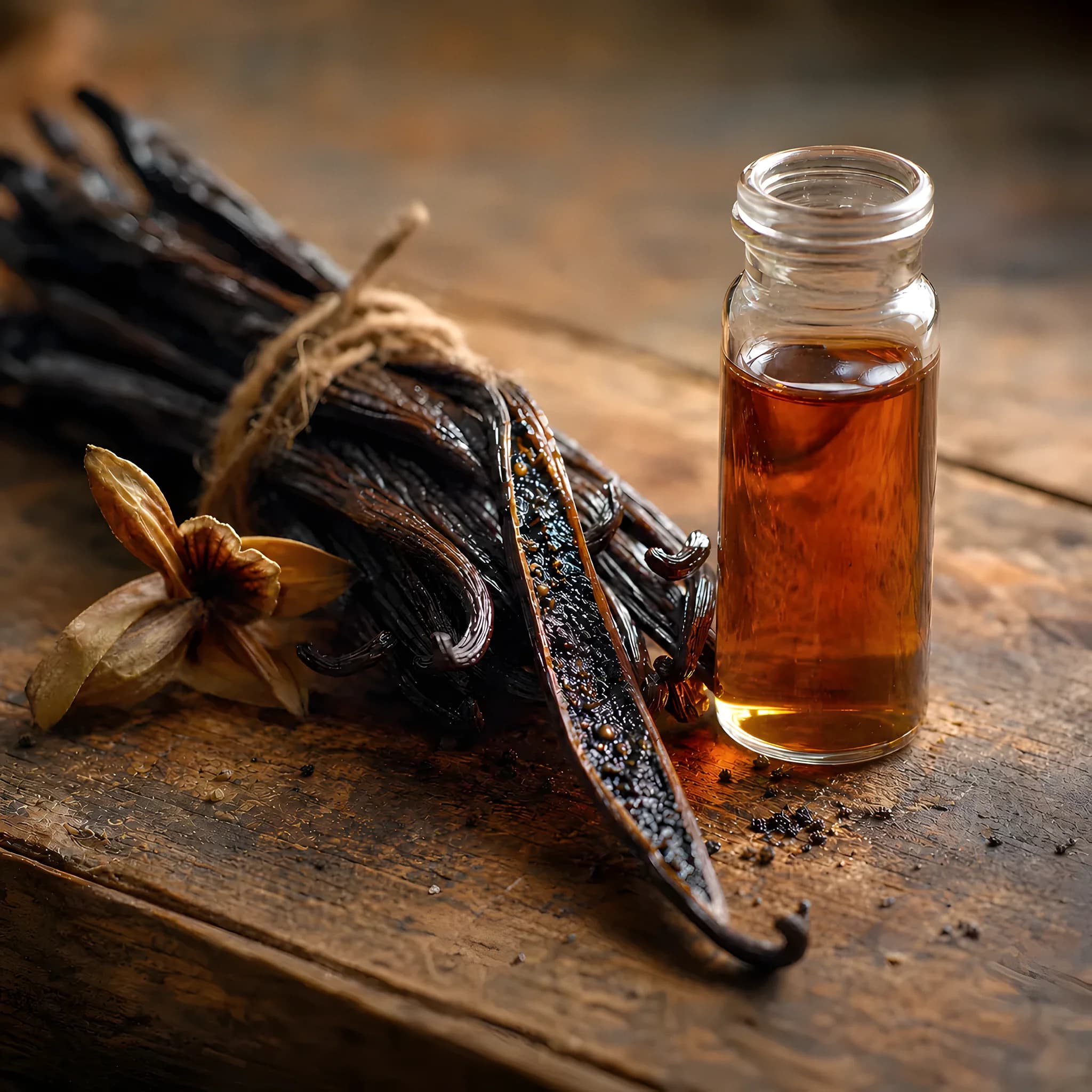
Vanillin is a single flavour compound, listed by JECFA as 4-hydroxy-3-methoxybenzaldehyde, and vanilla beans release it from vanillin glucoside during curing. A 2010 review in the Brazilian Journal of Microbiology reported that slightly less than 1% of world vanillin production came from natural vanilla, and a 2024 review in Biomolecules states that vanilla beans can meet about 1% of annual vanillin market demand. Reviews describe the other routes, including synthesis from guaiacol or eugenol, oxidation of lignin and microbial conversion of ferulic acid. Whether a particular vanillin may be called natural depends on its source and process, read against each market's own text. JECFA evaluated vanillin in 2001 and found no safety concern at the intakes then estimated for its use as a flavouring agent.
One Molecule, Several Numbers
JECFA lists vanillin as No. 889, with the synonyms vanillaldehyde, vanillic aldehyde and methylprotocatechuic aldehyde, and gives its FEMA number as 3107. In the EU Union list, in the consolidated text of 16 February 2026, vanillin is FL No 05.018, CAS 121-33-5. Ethyl vanillin has its own entry, FL No 05.019, CAS 121-32-4, JECFA No. 893, and JECFA set it a separate acceptable daily intake. Put the identifier on your specification so that a quotation for one is not read as the other.
Where the Vanillin in Vanilla Comes From
The 2024 Biomolecules review states that vanillin is present in green vanilla beans as vanillin glucoside, which is hydrolysed during curing to form the active flavour compound. The 2010 review names Vanilla planifolia as the main vanilla orchid source and also names Vanilla pompona. Our guide to vanilla extract versus vanilla flavour compares vanilla extract, vanilla flavouring and concentrates against the US standards and covers how to choose between them.
How Vanillin Is Made at Scale
The 2010 review states that, apart from the small share from natural vanilla, vanillin is synthesised by chemical processes. The 2024 review in Molecules describes three main industrial processes for producing synthetic vanillin. The first starts from eugenol, a constituent of clove oil, isomerises it to isoeugenol, converts the isoeugenol into an acetate to protect its hydroxyl group, and then oxidises it to vanillin. The second, the Riedel process, condenses glyoxylic acid with guaiacol to give vanillylmandelic acid and then vanillin, a reaction the review describes as highly regioselective towards the para position. The third converts guaiacol to vanillyl alcohol with formaldehyde and then to vanillin with oxygen.
Wood lignin is another source. The 2010 review reports that vanillin recovered from sulfite pulping liquor comes from the guaiacyl units of lignin, solubilised by alkaline oxidation during the pulping of softwoods. The 2024 Molecules review describes the industrial process as oxidation with molecular oxygen combined with alkaline hydrolysis of the lignin-rich fraction, at high temperature and high pH with a transition-metal catalyst, giving a vanillin yield of 5 to 7% of the starting material. The same 2024 review reported that only one company produced and sold vanillin made from lignosulfonate, a by-product of sulfite pulping of wood.
Microbial conversion is a further route. The 2010 review states that free ferulic acid can be obtained from common agricultural residues, grains and beet pulp through physical and enzymatic treatment, and that several bacteria metabolise ferulic acid to vanillin; it names Pseudomonas fluorescens as the most interesting and reports interesting vanillin concentrations from Amycolatopsis. The 2024 Biomolecules review describes a two-step conversion in which a CoA-independent ferulic acid decarboxylase turns ferulic acid into 4-vinylguaiacol and a carotenoid oxygenase turns that into vanillin.
The 2024 Molecules review states that a chemical and isotopic vanillin fingerprint can be detected, depending on the vanillin's origin and on the chemistry used to make it, and describes approaches combining at least two analytical methods as the most successful to date. If your claim depends on origin, ask your supplier which authentication method it relies on.
What the EU Text Says
In the consolidated text of Regulation (EC) No 1334/2008 dated 16 February 2026, Article 3(2)(b) defines a flavouring substance as "a defined chemical substance with flavouring properties". Article 3(2)(c) defines a natural flavouring substance as one obtained by appropriate physical, enzymatic or microbiological processes from material of vegetable, animal or microbiological origin, either raw or after processing for human consumption by one or more of the traditional food preparation processes listed in Annex II, and adds that natural flavouring substances correspond to substances that are naturally present and have been identified in nature. Annex II includes fermentation and microbiological processes in that list. Article 16(3) allows the term "natural flavouring substance(s)" only for flavourings whose flavouring component contains exclusively natural flavouring substances, and Article 16(4) allows "natural" with a named food, food category or source only where at least 95% by weight of the flavouring component has been obtained from that source. Vanillin appears in Annex I as FL No 05.018 with no restriction of use entered. Our article on what counts as a natural flavour compares the natural flavour definitions in EU, US and Singapore law and the Codex guideline.
What the US Text Says
In the United States, 21 CFR 101.22(a)(1) defines artificial flavour by exclusion and adds that it "includes the substances listed in §§ 172.515(b) and 182.60 of this chapter except where these are derived from natural sources". Section 182.60 lists vanillin and ethyl vanillin among the synthetic flavouring substances and adjuvants generally recognised as safe for their intended use. The natural flavour definition in 101.22(a)(3) includes flavouring constituents derived from the listed materials or "fermentation products thereof". Where an artificial flavour simulates, resembles or reinforces the characterising flavour, 101.22(i)(2) requires the name of that flavour, shown with the name of the food on the principal display panel, to carry the word "artificial" or "artificially flavored" in letters of a stated minimum size, and gives "artificial vanilla" as an example. Under 101.22(i)(4), a supplier of a flavour designated as containing no artificial flavour must certify in writing that, to the best of its knowledge and belief, the flavour contains none and that it has added none.
What Indonesia's BPOM Text Says
The English renderings of Indonesian provisions in this section are our own translations. Peraturan BPOM Nomor 13 Tahun 2020 on flavourings distinguishes natural, nature-identical and artificial flavouring substances. Pasal 1 angka 8 defines a natural flavouring substance (Senyawa Perisa Alami) as one obtained by physical, microbiological or enzymatic processes from plant or animal material, directly or after processing. Pasal 1 angka 12 defines a nature-identical flavouring substance (Senyawa Perisa Identik Alami) as one "diperoleh secara sintesis atau diisolasi melalui proses kimia dari bahan baku aromatik alami dan secara kimia identik dengan senyawa yang ada dalam produk alami", that is, obtained by synthesis or isolated by chemical processes from natural aromatic raw material, and chemically identical to a compound present in a natural product. Pasal 1 angka 13 defines artificial flavouring substances as chemically synthesised substances not yet identified in natural products, and Pasal 1 angka 15 prohibits a natural flavouring from containing nature-identical or artificial flavouring substances. As amended by PerBPOM 11/2021, Pasal 14 groups flavouring additives (BTP Perisa) for labelling as Perisa Alami or Perisa sintetik, the second comprising nature-identical and artificial flavourings.
In Lampiran III as first issued, vanillin is entry 889, with JECFA 889, FL 05.018 and FEMA 3107, permitted for food categories 01.0 to 15.0 except 13.1.1 infant formula, 13.1.2 follow-on and growing-up formula, and 13.2 foods for infants and young children. In the first-issued annexes, Lampiran V sets a maximum of 5 mg/100 mL of vanillin in follow-on and growing-up formula, and Lampiran VI a maximum of 7 mg/100 g in complementary foods for infants (MP-ASI), both calculated on the ready-to-consume product. Under the 2021 amendment, changes to these lists are set by decree of the Head of BPOM, so check for later decrees before relying on the first-issued values. Our Indonesia flavouring regulations reference covers BPOM permitted compounds, natural and synthetic label groups, written approval and halal certificate registration.
What Singapore's Text Says
Regulation 22(1) of Singapore's Food Regulations defines a flavouring agent as "any wholesome substance that when added or applied to food is capable of imparting taste or odour, or both, to a food". Regulation 22(6) requires the principles in natural flavouring essences or extracts to be derived from the plant after which the essence or extract is named. Regulation 22(9) includes within synthetic flavouring essences or extracts any artificial or imitation flavour whose flavouring principle is derived "in whole, or in part, from either chemical synthesis or any other sources that does not involve extraction or isolation" from an aromatic plant, fruit, vegetable or other food. In ingredient declarations, First Schedule item 11 permits "flavour or flavouring", qualified where applicable by "natural", "nature identical", "artificial" or a combination of those words. The Singapore Food Agency's guidance on food additives gives vanillin as an example of a flavouring agent and notes that flavouring agents "can be natural or synthetic". The same guidance states that food additives must meet JECFA specifications under regulations 15(2) and 15(4); regulation 15(4) requires a permitted food additive to meet the purity specifications provided in that Part of the Regulations and, where none are provided, those recommended by JECFA.
How JECFA Evaluated Vanillin
JECFA set an acceptable daily intake (ADI) for vanillin of 0 to 10 mg/kg body weight at its eleventh meeting in 1967 and maintained it at its fifty-seventh meeting in 2001, concluding: "No safety concern at current levels of intake when used as a flavouring agent." The 2001 evaluation assessed vanillin within a group of 46 structurally related hydroxy- and alkoxy-substituted benzyl derivatives. The ADI is based on a no-observed-effect level of 1000 mg/kg bw per day in a two-year feeding study in rats. The daily intakes the Committee estimated at that meeting, about 0.9 mg/kg bw in Europe and 2.5 mg/kg bw in the USA, did not exceed the ADI. JECFA retained a separate ADI of 0 to 3 mg/kg bw for ethyl vanillin at the same meeting.
Specifying Vanillin in a Brief
Name the substance by its FL, JECFA or FEMA number, list every market the product will be sold in, and ask which route and source material the vanillin comes from and how the supplier declares it under each of those markets' texts. To discuss vanillin or a vanilla profile for your product, send us a brief through our contact page.
Is vanillin natural?
It depends on the source, the process and the market. In the consolidated text of 16 February 2026, Article 3(2)(c) of EU Regulation 1334/2008 requires a natural flavouring substance to be obtained by appropriate physical, enzymatic or microbiological processes from vegetable, animal or microbiological material, raw or processed for human consumption by an Annex II process, and to correspond to a substance naturally present and identified in nature. In the United States, 21 CFR 101.22(a)(1) includes the substances listed in 21 CFR 182.60, among them vanillin, within artificial flavour except where they are derived from natural sources. Indonesia's PerBPOM 13/2020 and Singapore's Food Regulations, regulation 22, contain their own definitions; assess the supplier's declared source and process against each.
What is the difference between vanillin and vanilla extract?
Vanillin is one compound, 4-hydroxy-3-methoxybenzaldehyde. In green vanilla beans it is present as vanillin glucoside, which is hydrolysed during curing to release it. A 2024 review states that vanilla beans can meet about 1% of annual vanillin market demand. Our guide to vanilla extract versus vanilla flavour compares the extract and flavouring products themselves.
Is vanillin safe to eat?
JECFA set an ADI of 0 to 10 mg/kg body weight for vanillin in 1967 and maintained it in 2001, when it concluded, on the intakes estimated at that meeting: "No safety concern at current levels of intake when used as a flavouring agent."
How is synthetic vanillin made?
A 2024 review describes three main industrial processes for synthetic vanillin: a route from eugenol through isoeugenol and an acetate intermediate, and two routes from guaiacol, one using glyoxylic acid and the other passing through vanillyl alcohol. Beyond these synthetic routes, reviews describe vanillin production from lignosulfonate from wood pulping and by microbial conversion of ferulic acid.
Sources
- JECFA, Summary of evaluations: Vanillin (JECFA No. 889), page dated 29 January 2003, reporting the 2001 evaluation
- WHO Food Additives Series 48 (2002), Hydroxy- and alkoxy-substituted benzyl derivatives, 57th JECFA meeting
- Santos, Lautru and Pernodet, Genetic Engineering Approaches for the Microbial Production of Vanillin, Biomolecules 14(11):1413 (2024)
- Converti et al., Microbial Production of Biovanillin, Brazilian Journal of Microbiology 41(3):519-530 (2010)
- D'Arrigo et al., From Waste to Value: Recent Insights into Producing Vanillin from Lignin, Molecules 29(2):442 (2024)
- Regulation (EC) No 1334/2008 on flavourings, Articles 3(2) and 16, Annexes I and II (consolidated text 16.02.2026)
- US 21 CFR 101.22, Foods; labeling of spices, flavorings, colorings and chemical preservatives (eCFR point-in-time 2026-09-01)
- US 21 CFR 182.60, Synthetic flavoring substances and adjuvants (eCFR point-in-time 2026-09-01)
- PerBPOM 13/2020 (adopted 30 June 2020, promulgated 2 July 2020), Pasal 1 angka 8, 12, 13 and 15; Lampiran III, V and VI as first issued
- PerBPOM 11/2021 (19 April 2021), amending PerBPOM 13/2020, Pasal 6, 11 and 14
- Singapore Food Regulations, regulation 22 (Flavouring agents), version as at 10 October 2026
- Singapore Food Regulations, regulation 15 (Food additives), version as at 10 October 2026
- Singapore Food Regulations, First Schedule, item 11, version as at 10 October 2026
- Singapore Food Agency, Guidance Information on Requirements for Food Additives (updated 19 January 2026)