No, vanilla concentrate is not necessarily vanilla extract. US standards distinguish concentrated vanilla extract from concentrated vanilla flavouring. Confirm the product identity and the applicable local rules with your supplier.
Vanilla extract and vanilla flavouring are not the same product, despite often being treated as interchangeable. Walk through any baking aisle and you'll find both, sometimes for very different prices, and yet most buyers cannot say what separates them. For home bakers, the distinction often comes down to budget. For food and beverage manufacturers, it has real implications for labelling claims, regulatory compliance, cost structure, and end-product sensory profile. This guide explains the difference, what each is made of, when each is the right choice, and where the surrounding category names like 'vanilla concentrate', 'vanilla flavour', and 'baking vanilla' fit in.
Extract is a Regulated Category
Vanilla extract is a regulated product. In the United States, the Code of Federal Regulations (21 CFR 169.175) defines pure vanilla extract as a solution of the flavouring substance from vanilla beans in an aqueous alcohol mixture. It must contain at least 35% alcohol by volume and at least one unit weight of vanilla beans per gallon, where a unit is 13.35 ounces of beans containing no more than 25% moisture (21 CFR 169.3). Anything labelled 'pure vanilla extract' that doesn't meet these minimums is mislabelled. The EU takes a different route: it sets no compositional standard for the product 'vanilla extract', but Regulation (EC) No 1334/2008 governs when a flavouring may be named a 'natural vanilla flavouring' (at least 95% of the flavouring component, by weight, from vanilla). Vanilla extract is a specific, narrow category with a legally protected definition built around real vanilla bean content and a specific alcohol-water ratio.
Vanilla Flavouring Has a US Standard
In the United States, vanilla flavouring is a standardised food under 21 CFR 169.177, not a general label for synthetic vanillin. Concentrated vanilla flavouring has its own standard under 21 CFR 169.178. A product flavoured with synthetic vanillin cannot be labelled simply 'vanilla extract' or 'vanilla flavoring'; it must be labelled as artificial or imitation. The separate vanilla-vanillin extract, flavouring and powder standards are set out in 21 CFR 169.180, 169.181 and 169.182. Outside the United States, the applicable local rules determine how a vanilla product may be named.
Why Both Exist
Both exist for three reasons. First, alcohol content matters in some applications and not in others. Extract's 35%+ alcohol is great for ice cream and cold desserts but burns off rapidly in baked goods, where the flavour can become less pronounced. Vanilla flavouring with no or low alcohol holds up better through heat. Second, price. Real vanilla beans are an agricultural commodity, so their cost moves with weather, pests and market conditions in the growing regions, of which Madagascar is the main origin. Vanilla extract follows bean pricing. Artificial vanilla flavouring is far cheaper and price-stable. Third, regulatory and labelling. If you are making an organic-certified product, you need natural extract. If you are making a cost-driven mass-market product, you might choose artificial flavouring. Same end-product category, different upstream choice.
What They Actually Taste Like
On taste, the differences are real but smaller than most people think. Pure vanilla extract has greater aromatic complexity because the vanilla bean contains hundreds of volatile compounds beyond just vanillin. Natural vanilla flavouring without alcohol carries the same compounds in a different carrier; sensory panels can usually tell them apart but consumers rarely can in a finished baked good. Artificial vanilla flavouring tastes flatter and more one-dimensional in side-by-side tasting, but in a chocolate chip cookie or a cake batter, the difference is often imperceptible. This is why so many commercial bakeries use artificial flavouring without quality complaints. The flavour difference only shows up in applications where vanilla is the star (custards, vanilla ice cream, French vanilla products).
What 'Baking Vanilla' Means
The 'baking vanilla' label deserves its own note. Baking vanilla typically refers to a vanilla flavouring with lower alcohol content (often 2-4% instead of 35%+) optimised for heat stability in baked goods. Some baking vanillas use water and glycerin as the primary carrier rather than alcohol. In the United States, a product meeting 21 CFR 169.177 may be labelled 'vanilla flavoring'; one flavoured with synthetic vanillin must be labelled as artificial or imitation. 'Baking vanilla' is a marketing term and does not replace the required identity. This is often why a home-baked vanilla cake tastes different from a commercial one: commercial bakeries use heat-stable vanilla flavouring, while home recipes often call for extract designed for cold applications.
How to Choose
If you are choosing between extract and flavouring, the decision matrix is straightforward. Choose pure vanilla extract when: the product is unheated or low-heat (ice cream, mousse, beverages, fillings), the label claim matters (organic, premium, clean-label positioning), and the product's success depends on vanilla being the standout flavour. Choose vanilla flavouring, or an appropriately labelled artificial or imitation vanilla product, when: the product is heat-processed (most baked goods, some confectionery), cost stability matters more than label premium, and vanilla is a supporting note rather than the hero. Many large manufacturers use both, deploying extract in their premium tier products and flavouring in their value tier, often within the same brand family.
FEMA 3105 and 3106 Now Cover Vanilla pompona
One identity question was widened in 2026 and it is worth checking against your specification. FEMA's Interim GRAS 32 list, published July 2026, records under corrections that “The botanical Vanilla pompona is also considered FEMA GRAS under the identities of FEMA 3105 and FEMA 3106”. Those two numbers are vanilla extract and vanilla oleoresin, which previously read across to Vanilla planifolia and Vanilla tahitensis. So a material declared to FEMA 3105 may now be built on a third species. 21 CFR 169.3(a) defines vanilla beans as Vanilla planifolia and Vanilla tahitensis. FEMA GRAS recognition of other species, including Vanilla pompona, does not change the United States standard of identity for vanilla extract. It does mean that if your brief depends on a particular species, name the species rather than relying on the FEMA number to carry it.
Where Concentrates Fit
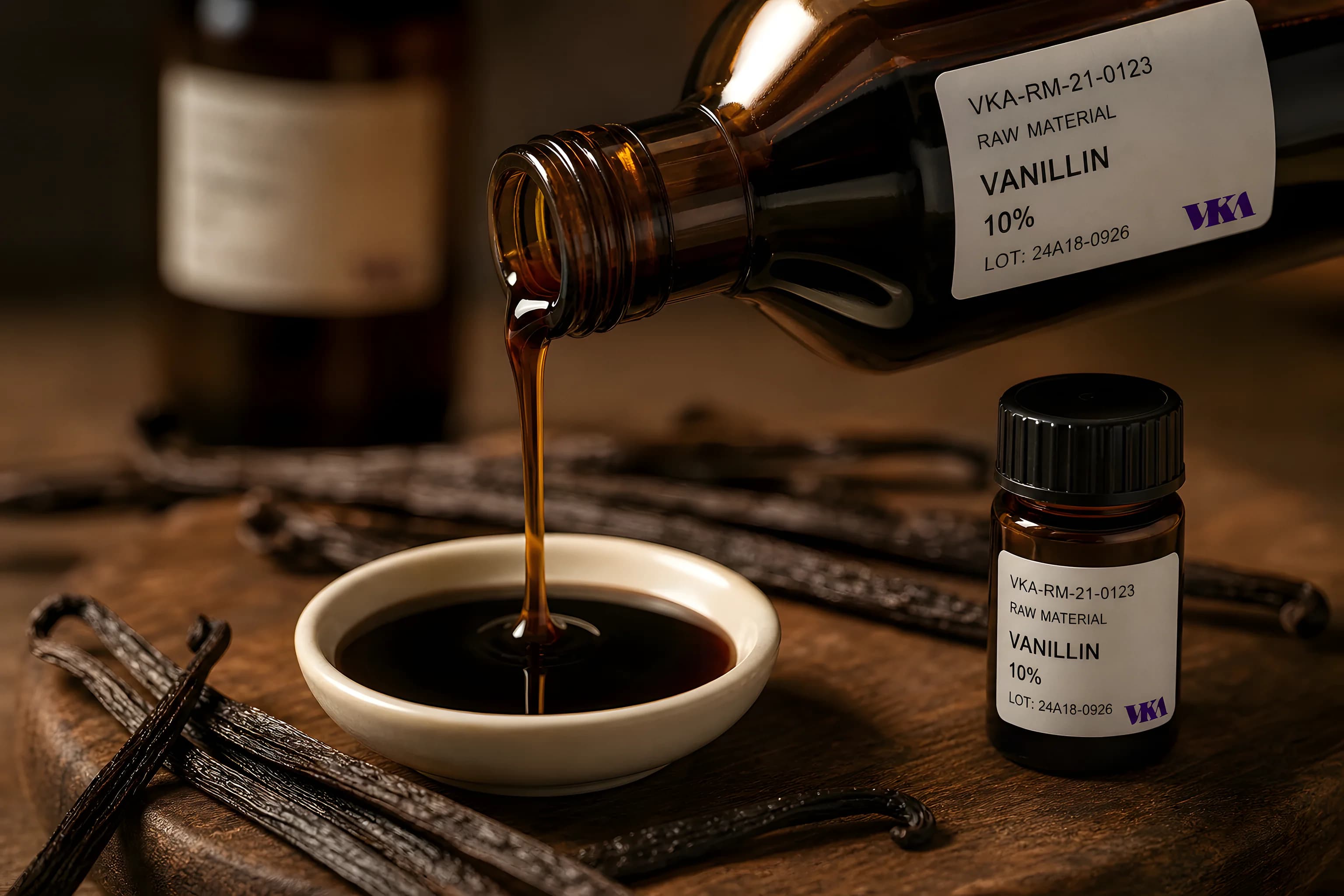
Vanilla concentrate needs a precise specification. In the United States, concentrated vanilla extract is a separate standard of identity under 21 CFR 169.176, distinct from vanilla extract under 21 CFR 169.175. Under 21 CFR 169.176, concentrated vanilla extract meets the vanilla extract standard except that it is concentrated to remove part of the solvent: each gallon contains two or more units of vanilla constituent, and the ethyl alcohol content stays at not less than 35 percent by volume. Its name states the fold, for example 'Concentrated vanilla extract 2-fold', the number being the whole number of units of vanilla constituent per gallon, with fractions disregarded. Concentrated vanilla flavouring is separately standardised under 21 CFR 169.178. The term 'concentrate' alone does not establish which standard a product meets. These concentrated products are used in industrial applications where small dosage volumes need to deliver strong flavour, like beverage syrups, dairy applications, and large-batch confectionery.
How VKA Develops Vanilla
At VKA we develop natural vanilla flavours, vanilla concentrates, and custom vanilla profiles for your food and beverage products in APAC. Our natural vanilla profiles are built on Bourbon-type bean chemistry; heat-stable and cost-led vanilla notes are specified separately. Whether you need a cold-application vanilla ice cream profile, a heat-stable baking vanilla, or a low-cost vanilla note for confectionery, the choice and the specification are yours. Browse our Essences Portfolio which covers vanilla and other true-to-nature flavour profiles, or talk to a flavourist directly about your specific brief.
Vanilla flavours for Philippine manufacturers
Developing a vanilla product for the Philippines? Explore our flavour supply for Philippine manufacturers and request a sample for your application.
Rujukan
- US FDA, 21 CFR 169.3 - Vanilla bean species, terms and unit weight
- US FDA, 21 CFR 169.175 - Vanilla extract
- US FDA, 21 CFR 169.176 - Concentrated vanilla extract
- US FDA, 21 CFR 169.177 - Vanilla flavouring
- US FDA, 21 CFR 169.178 - Concentrated vanilla flavouring
- US FDA, 21 CFR 169.180 - Vanilla-vanillin extract
- US FDA, 21 CFR 169.181 - Vanilla-vanillin flavouring
- US FDA, 21 CFR 169.182 - Vanilla-vanillin powder
- EU Regulation (EC) No 1334/2008, Article 16 - naming of flavourings
- FEMA, Interim GRAS 32 list, July 2026, Corrections and Errata to previous GRAS Publications