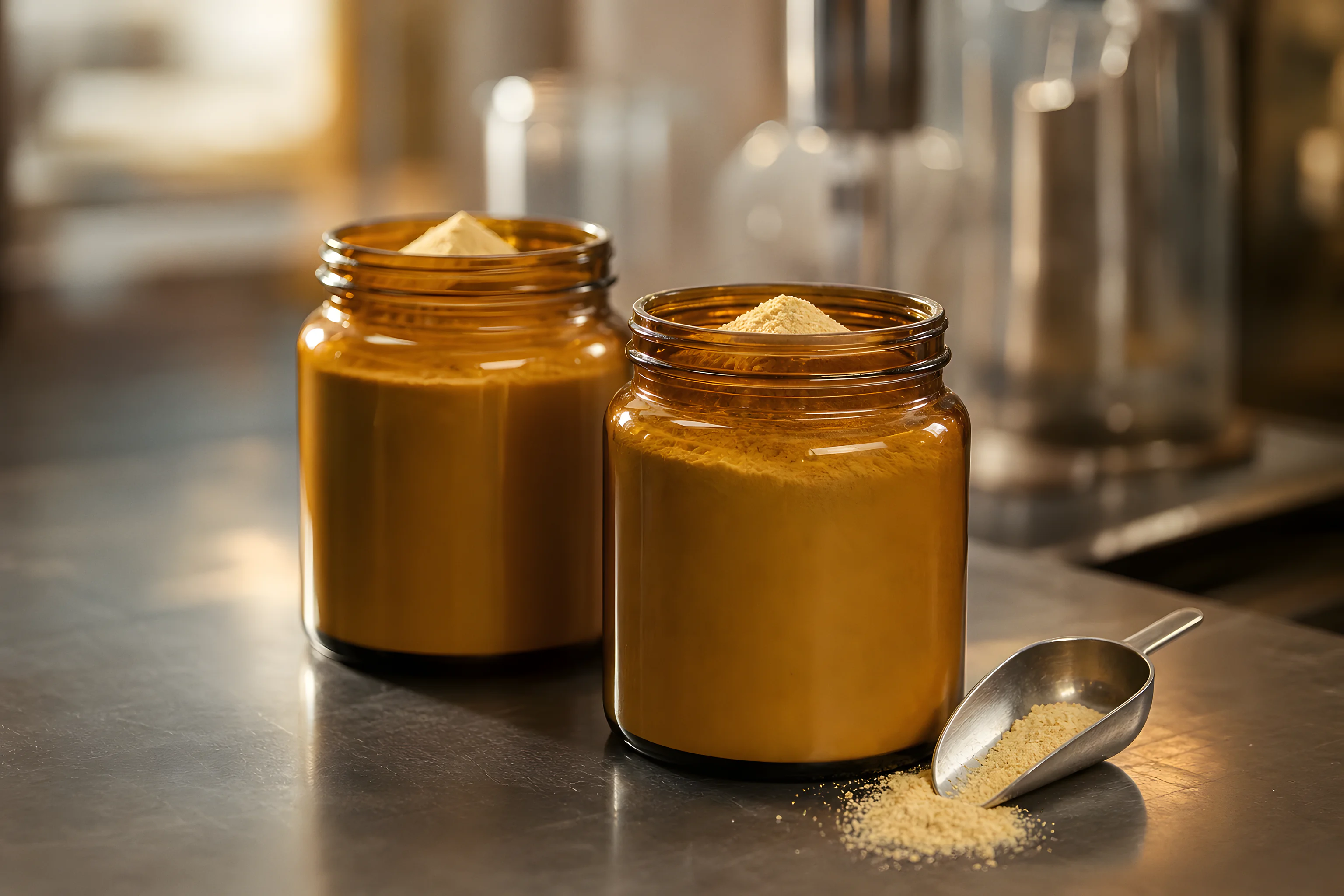
Flavour encapsulation is the process of wrapping volatile flavour compounds inside a protective carrier material, so a fragile liquid flavour becomes a stable powder that survives manufacturing and storage. It shields the aroma from heat, oxygen, light and time, and it lets the flavour release where and when it is wanted. EssenceLock is VKA's encapsulation technology built on that principle: protect the taste you designed so the consumer actually receives it.
Why Flavour Needs Protecting
The compounds that give a flavour its character are volatile by nature, which is exactly why we can smell and taste them, and it is also why they are fragile. They evaporate, they react with oxygen, and they break down under heat and light. A recent review of the field describes encapsulation as a way of reducing the volatility, oxidation, evaporation, and the thermal, photo and chemical degradation of flavour substances. The practical consequence for a manufacturer is familiar: a flavour that was perfect on the bench can arrive weaker, flatter or out of balance in the finished product, because the most delicate top notes are the first to be lost through processing and shelf life.
What Encapsulation Actually Is
Encapsulation puts the flavour, the core, inside a wall of carrier material, and the result is most often a fine, free-flowing powder rather than a liquid. The wall materials are food-grade and carry GRAS (generally recognised as safe) status; the common ones are carbohydrates such as maltodextrin, gum arabic and modified starch, proteins such as whey and soy, and molecular hosts such as cyclodextrins. The choice of wall, and how thick it is, decides how well the flavour is protected and how it is released, which is why encapsulation is engineered for a specific product rather than applied as a single recipe.
The Methods, and Why Spray Drying Leads
There are several ways to build that wall. Reviews of the field group them into physical and mechanical methods such as spray drying, spray chilling, freeze drying and extrusion, and physicochemical methods such as coacervation, emulsification and molecular inclusion with cyclodextrins. In industry one method dominates: spray drying is the most widely employed technique for producing powdered flavour, because it is rapid, simple, relatively cost-effective and runs continuously at scale. Its one real trade-off is heat, since the drying step can degrade the most heat-sensitive compounds, so the formulation has to be designed to protect them rather than treating it as an afterthought.
What Encapsulation Buys You
Done well, encapsulation does several jobs at once. It protects the flavour through processing, so the heat, mixing, extrusion and baking that a product goes through no longer strip out the aroma. It extends shelf stability, shielding the volatile compounds from the oxygen and light that dull a flavour over months on the shelf. It allows controlled or sustained release, so a flavour can be held back and then delivered at the right moment, on heating, on contact with moisture, or steadily over time. And it converts an awkward liquid into a free-flowing powder that is easier to weigh, dose and blend into a dry mix. The same protective shell can also help hold back an off-note until it is no longer noticeable.
Where It Matters Most
Encapsulation earns its keep wherever a flavour has to survive something. Bakery is the clearest case: a bake-stable flavour has to pass through a hot oven and still taste right in the finished crumb, which a protected compound can do where a raw liquid would flash off. Dry beverage mixes, instant products, seasonings and soup bases rely on encapsulation to turn liquid flavours into stable powders that blend evenly and keep their strength in the pack. Confectionery and chewing gum use it for timed release, holding a flavour back so it lasts through the chew. In each case the right shell material and thickness depend on the heat, moisture and shelf life the product will actually face, so the encapsulation is matched to the process, not chosen in the abstract.
How EssenceLock Works
EssenceLock is VKA's encapsulation technology, and it follows that same logic of matching the protection to the product. It runs in four steps. First, compound analysis: we identify which volatile compounds in your flavour are the most vulnerable to heat, oxidation and time, because those are the notes worth protecting. Second, barrier engineering: our encapsulation team selects the shell material and thickness for your specific application and processing conditions. Third, application testing: we run the flavour through real processing and accelerated shelf-life tests, measuring how much flavour is retained at each stage rather than assuming it. Fourth, production scale-up: once it is validated, EssenceLock integrates into your existing line with technical support, so it works within your setup rather than forcing a reformulation around it.
Why Efficiency Is Not Performance
One published finding should change how an encapsulation specification is read, and it cuts against the number suppliers quote most often. A 2026 review in the International Journal of Food Science states that “high encapsulation efficacy is not necessarily enhanced in shelf life, sensory, or physiological efficacy in realistic processing and storage, as well as gastrointestinal processes”. An encapsulation-efficiency percentage describes how much flavour went into the capsule, not how much reaches the consumer, and the two do not track each other through a real process. The useful question to ask a supplier is retention measured in your matrix, through your process, over your shelf life, which is exactly what the application-testing step above exists to produce.
What the Loading Curve Shows
Load level is a formulation decision rather than a dial to turn up, and there is a measured curve that shows why. A 2026 study in Foods, building vanillin complexes on soy protein isolate, reports that “The binding efficiency of vanillin decreased from 91.03 wt.% to 69.43 wt.% with increasing vanillin loading”, with vanillin nanocrystals forming and aggregating above 33.33 wt.% relative to the protein. Those are someone else's laboratory numbers on one carrier in a model system, not a VKA figure and not a shelf-life claim. What transfers is the shape of the curve: push the load and the proportion you hold falls, so the highest load is rarely the highest delivered flavour.
Questions Manufacturers Ask
Does encapsulation change the flavour itself? No. The profile is designed first, and encapsulation protects and delivers that same flavour; the aim is for the finished product to taste like the bench-top sample, not like something new.
Will an encapsulated flavour survive baking? It can, if the shell and the flavour load are engineered for the heat and moisture of that specific bake. That is the whole point of matching the barrier to the application rather than using one powder everywhere.
Is an encapsulated flavour harder to use in production? Usually the opposite. A free-flowing powder is often easier to dose and to blend evenly into a dry mix than a liquid, though the right format still depends on your process, which is what application testing is for.
Protecting the Flavour You Designed
The flavour profile you spend months perfecting is only worth what reaches the consumer, and the gap between the two is flavour loss through heat, oxygen and time. Encapsulation is how that gap is closed, and EssenceLock is how VKA closes it: vulnerable compounds identified, a barrier engineered for your process, retention measured through real production and shelf life, and the whole thing scaled into your existing line. To see what it could do for a specific product, explore our wider flavour solutions or talk to a flavourist directly about your processing conditions and the notes you cannot afford to lose.
Sources
- Frontiers in Nutrition (2023) - Flavour encapsulation: a comparative analysis of techniques, stability and food applications
- Food Chemistry (2026) - Locking in flavor: aroma chemistry and spray-drying encapsulation strategies
- Encapsulation in Food Systems, International Journal of Food Science (2026), doi 10.1155/ijfo/7367634
- Dual-Stabilized Vanillin Complexes Based on Soy Protein Isolate, Foods 15(7):1240 (5 April 2026)