The major compound behind pandan leaf's characteristic flavour is 2-acetyl-1-pyrroline, or 2AP, according to a 2010 extraction study in the Journal of Supercritical Fluids. Fang and Cadwallader, writing in the Journal of Agricultural and Food Chemistry in 2014, describe 2AP as highly unstable, and Surojanametakul and colleagues report in a 2019 study that fresh pandan leaf extract deteriorates quickly and its flavour changes. For anyone buying or specifying pandan extract, pandan essence or pandan flavouring, that leaves four questions: how much 2AP an extract holds, what has been shown to protect it, how heat and starch affected it in published trials, and how food safety evaluators list it. This guide takes them in turn.
One compound carries the pandan note
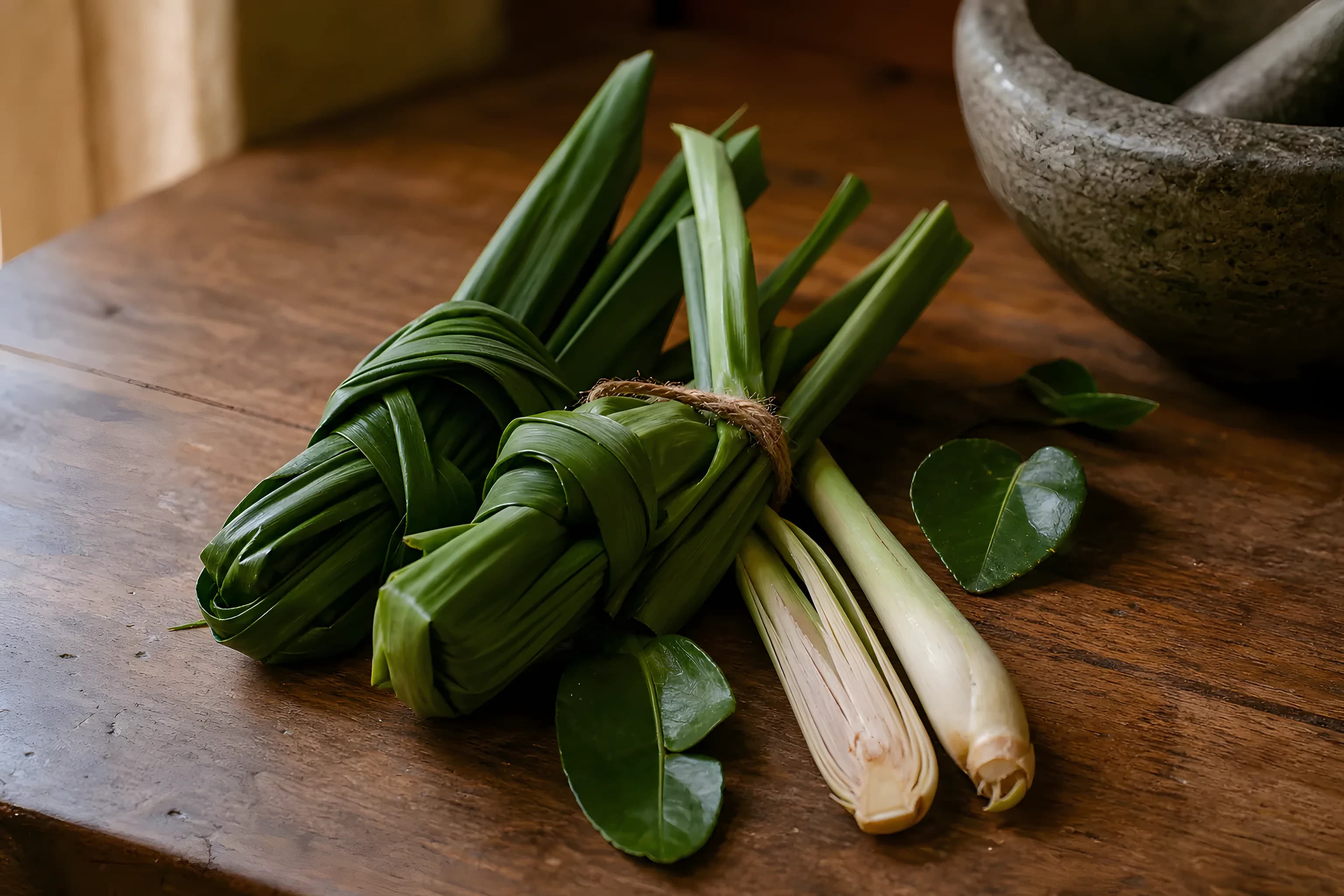
Pandan leaf, Pandanus amaryllifolius Roxb., is a source of natural flavouring widely used in Southeast Asia, and the 2010 study names 2AP as the major compound contributing to its characteristic flavour. The same authors note that 2AP contributes significantly to the flavour of aromatic rice such as basmati and jasmine, and a 2017 review in Food Chemistry lists it as important in the aroma of pandan leaf, popcorn and Mediterranean sausage as well as fragrant rice. A 2025 study in Foods recounts Buttery's early finding that 2AP was ten times more abundant in pandan leaves than in aromatic rice. Surojanametakul and colleagues, citing earlier work, give its odour threshold as low as 0.1 parts per billion in water.
The leaf carries more than 2AP. The 2025 Foods study identified 93 volatile compounds and named 13 main aroma volatiles, among them 2AP, hexanal, nonanal, phenylacetaldehyde and β-cyclocitral. A pandan flavour built on 2AP alone leaves those other compounds out, which is worth keeping in mind when the brief is for the taste of the leaf itself.
Why the aroma fades
In their 2014 paper, Fang and Cadwallader state that 2AP is scarcely used commercially in flavours because of its highly unstable nature. In 2018, Hausch and colleagues described it as scarcely used as a flavouring agent due to its great instability. A 2017 review of the compound's first thirty-three years notes that its unstable nature delayed its discovery, and concludes that more research on its stability is needed to make its use as a food additive easier.
The leaf and its juice are perishable too. The 2025 Foods study cites the considerable loss of aroma and the perishability caused by moisture in pandan leaves as the reasons for common pre-treatments such as dehydration, thermal processing and freeze-drying. Surojanametakul and colleagues, citing earlier work, link the instability of colour and flavour to light, temperature and oxidation. The raw material varies as well: a study published in December 2024 in Food Chemistry: X found 2AP content higher at leaf positions L1 to L3, decreasing as the leaf grew.
How pandan extract is made
In the 2010 study, Yahya and colleagues extracted pandan leaves with supercritical carbon dioxide and with hexane, and found that the initial moisture content and particle size of the leaves had the greatest effect on total yield and on 2AP concentration. Supercritical extract yields were ten times lower than hexane extract yields, and both kinds of extract from pre-treated leaves held small quantities of 2AP, between 0.04 and 0.45 ppm (each figure ± 0.01). Grinding was the best pre-treatment for both methods, and freeze drying was the best drying method for supercritical extraction.
A 2022 study in Molecules used ultrasound with a mix of ethanol and water, and found that the mass of leaves and the solvent concentration had a significant effect on 2AP extraction. Its reported optimum, 20 minutes at 25 per cent amplitude with 60 per cent ethanol in water by volume and 12.5 g of leaves, gave an extract containing 1.43 ppm of 2AP. The same paper, citing earlier work, notes that pandan leaves only give off their aroma once they are withered, cooked or pounded. The two studies used different extraction methods, and both report extract 2AP in parts per million. Surojanametakul and colleagues describe chlorophyll as the natural green colour in fresh aqueous pandan leaf extract, so an extract of that kind brings colour as well as flavour.
Protecting 2AP: what the research shows
The studies below bind 2AP, dry it, or both. Fang and Cadwallader bound 2AP to zinc halides, forming stable crystalline complexes that release the free odorant when hydrated, and a zinc iodide complex kept more than 94 per cent of its 2AP after three months at ambient temperature in a dry environment. In a 2019 Food Chemistry paper, Yin and Cadwallader coated a zinc chloride complex in paraffin by spray chilling and found significantly greater 2AP stability than in the unprotected complex at all four humidities tested, from about 0 to about 100 per cent relative humidity. Hausch and colleagues complexed 2AP with high amylose corn starch, and over half of the flavour was retained after two weeks at 0 per cent relative humidity. The authors say these methods may enable, or have potential for, commercial use, so treat them as research directions.
For pandan extract itself, Surojanametakul and colleagues spray dried fresh leaf extract with rice starch and gum acacia. Over ten weeks of storage at 30 °C, the glutinous rice starch aggregates lost 12 to 29 per cent of their 2AP and the non-glutinous ones 10 to 20 per cent, and every powder lost some 2AP. The same paper reports that Apintanapong and Noomhorm found 30 per cent of the 2AP in a gum acacia and maltodextrin capsule had degraded after 35 days. Water released the bound 2AP in the zinc complexes, and the corn starch complexes were stored at 0 per cent relative humidity, which is reason enough to put the packaging and storage humidity of a pandan powder in its specification. Our guide to flavour encapsulation covers what encapsulation is, the main methods and what they protect against, and how long flavours last explains how a flavour's shelf life is set and why water activity governs a powder.
What processing does to the pandan note
Heating can form 2AP in rice. The 2017 Food Chemistry review explains that 2AP is formed as part of the Maillard reaction when rice is heated, from reducing sugar breakdown products and 1-pyrroline derived from the amino acids proline and ornithine. In a 2024 study of pandan-flavoured sponge cake, heating pandan leaf juice raised the number of odour-active compounds from 9 in the fresh juice to 17 in the heated sample, and intensified the original roasted and steamed rice-like odours.
Heating released 2AP in two of the studies above. In the rice starch aggregates, encapsulated 2AP was released into the headspace when the starch gelatinised, and heating to 80 °C released roughly five to eight times as much 2AP as at room temperature. In Yin and Cadwallader's instant rice trial, cooking showed the controlled release of the microcapsules and gave full 2AP recovery. Our guide to heat-stable flavours for bakery covers what the oven does to an added flavour more generally.
Colour follows its own rules. Surojanametakul and colleagues note, citing earlier work, that chlorophyll degrades to pheophytin with dilute acids, heat, light or oxygen, turning bright green to olive brown. In the sponge cake study, adding pandan leaf juice decreased crust brightness, and the green colour was apparent only in the crumb. In an acidic or long-heated product, plan the green separately from the flavour.
Regulatory status of 2AP
The IPCS INCHEM summary of evaluations by the Joint FAO/WHO Expert Committee on Food Additives (JECFA) lists 2-acetyl-1-pyrroline as a flavouring agent, JECFA No. 1604 and FEMA No. 4249. JECFA's latest evaluation, in 2005, gave the comment "No safety concern (conditional) at current levels of intake when used as a flavouring agent". The entry explains that the evaluation was conditional because the estimated daily intake was based on the anticipated annual volume of production, and that the conclusion would be revoked if use levels or poundage data were not provided before the end of 2007. Confirm the current JECFA position before relying on this evaluation in a dossier.
FEMA's Flavor Library lists 2-acetyl-1-pyrroline as FEMA Number 4249, with JECFA Number 1604 and CAS 85213-22-5. Before use, check each market you sell into against its own permitted list and labelling rules, including whether a pandan product can be described as natural. Our guide to natural flavours sets out how the EU, the United States, Singapore and Codex define a natural flavouring.
What to put in a pandan brief
Include the process and the product in your brief: the heat step with its temperature and time, whether the product is acidic, the moisture and packaging of a powder, the shelf life and storage conditions you need, and whether the flavour should supply green colour. State the label wording you intend (leaf extract, natural flavouring or flavouring) and check it against the requirements in each market you sell into.
If you are developing a pandan product, send us a brief with the application, the process and the shelf life you need.
What is the difference between pandan extract, pandan essence and pandan flavouring?
Ask the supplier for the product's composition. Published pandan extraction methods include supercritical carbon dioxide and hexane (Yahya and colleagues, 2010) and ultrasound with ethanol and water (Azhar and colleagues, 2022), so ask which solvent was used and how much 2AP the extract carries. For an essence or a flavouring, ask which flavouring substances were added. 2AP itself was evaluated by JECFA in 2005 as a flavouring agent, and FEMA's Flavor Library lists it as FEMA Number 4249. Confirm which labelling category applies in each market you sell into; our guide to natural flavours sets out the EU, US, Singapore and Codex definitions.
Why does pandan flavour fade?
The major compound behind pandan leaf's characteristic flavour is 2-acetyl-1-pyrroline, which researchers describe as highly unstable, and Surojanametakul and colleagues report that fresh pandan leaf extract deteriorates quickly. Encapsulated pandan extract still lost 2AP in their study: spray-dried rice starch aggregates lost 10 to 29 per cent over ten weeks at 30 °C. In the zinc complexes studied by Fang and Cadwallader, water released the bound 2AP, so keep pandan powders dry and sealed.
What happens to pandan flavour when it is heated?
Heating can form 2AP in rice, according to a 2017 review in Food Chemistry. In a 2024 sponge cake study, heating pandan leaf juice raised its odour-active compounds from 9 to 17 and intensified the roasted and steamed rice-like odours. In the rice starch aggregates studied by Surojanametakul and colleagues, heating to 80 °C with gelatinisation released roughly five to eight times as much 2AP as at room temperature. In the sponge cake study, the pandan green was apparent only in the crumb.
Is 2-acetyl-1-pyrroline approved as a food flavouring?
JECFA evaluated 2AP in 2005 as a flavouring agent, with "No safety concern (conditional) at current levels of intake", on condition that use levels or poundage data were provided before the end of 2007. FEMA's Flavor Library lists it as FEMA Number 4249. Check the current JECFA position and each market's permitted list before use.
Sources
- Yahya, Lu, Santos, Fryer and Bakalis, Supercritical carbon dioxide and solvent extraction of 2-acetyl-1-pyrroline from Pandan leaf: The effect of pre-treatment, Journal of Supercritical Fluids 55(1):200-207 (2010), doi 10.1016/j.supflu.2010.05.027
- Azhar, Amran, Yusup and Mohd Yusoff, Ultrasonic Extraction of 2-Acetyl-1-Pyrroline (2AP) from Pandanus amaryllifolius Roxb. Using Ethanol as Solvent, Molecules 27(15):4906 (2022)
- Tang, Chen, Liu, Li, Luo, Chen and Wu, Comprehensive Characterization of Aroma Profile of Glutinous Rice Flavor in Pandanus amaryllifolius Roxb., Foods 14(6):935 (2025)
- Wei, Handoko, Pather, Methven and Elmore, Evaluation of 2-acetyl-1-pyrroline in foods, with an emphasis on rice flavour, Food Chemistry 232:531-544 (2017)
- Fang and Cadwallader, Stabilization of the potent odorant 2-acetyl-1-pyrroline and structural analogues by complexation with zinc halides, Journal of Agricultural and Food Chemistry 62(35):8808-8813 (2014)
- Hausch, Little, Kenar and Cadwallader, Starch-Flavor Complexation Applied to 2-Acetyl-1-pyrroline, Journal of Agricultural and Food Chemistry 66(44):11718-11728 (2018)
- Yin and Cadwallader, Spray-chilling encapsulation of 2-acetyl-1-pyrroline zinc chloride using hydrophobic materials: Storage stability and flavor application in food, Food Chemistry 278:738-743 (2019)
- Surojanametakul, Boonbumrung, Tungtrakul, Varanyanond, Themtakul and Yoshihashi, Encapsulation of Natural Flavor from Pandanus amaryllifolius Roxb. in Rice Starch Aggregates, Food Science and Technology Research 25(4):577-585 (2019)
- Chen, Cao, Lan, Gu, He, He and Zhao, Quality-Driven Design of Pandan-Flavored Sponge Cake: Unraveling the Role of Thermal Processing on Typical Pandan Aroma, Foods 13(19):3074 (2024)
- Yan, Zhang, Qin et al., Changes in key volatile components associated with leaf quality of Pandanus amaryllifolius Roxb. alongside growth duration, Food Chemistry: X 25:102126 (2024)
- Wakte, Zanan, Hinge, Khandagale, Nadaf and Henry, Thirty-three years of 2-acetyl-1-pyrroline, a principal basmati aroma compound in scented rice: a status review, Journal of the Science of Food and Agriculture 97(2):384-395 (2017)
- IPCS INCHEM, Summary of JECFA evaluations: 2-Acetyl-1-pyrroline, JECFA No. 1604 (latest evaluation 2005), retrieved 10 October 2026
- FEMA Flavor Library, 2-Acetyl-1-pyrroline, FEMA 4249 (undated page, retrieved 10 October 2026)