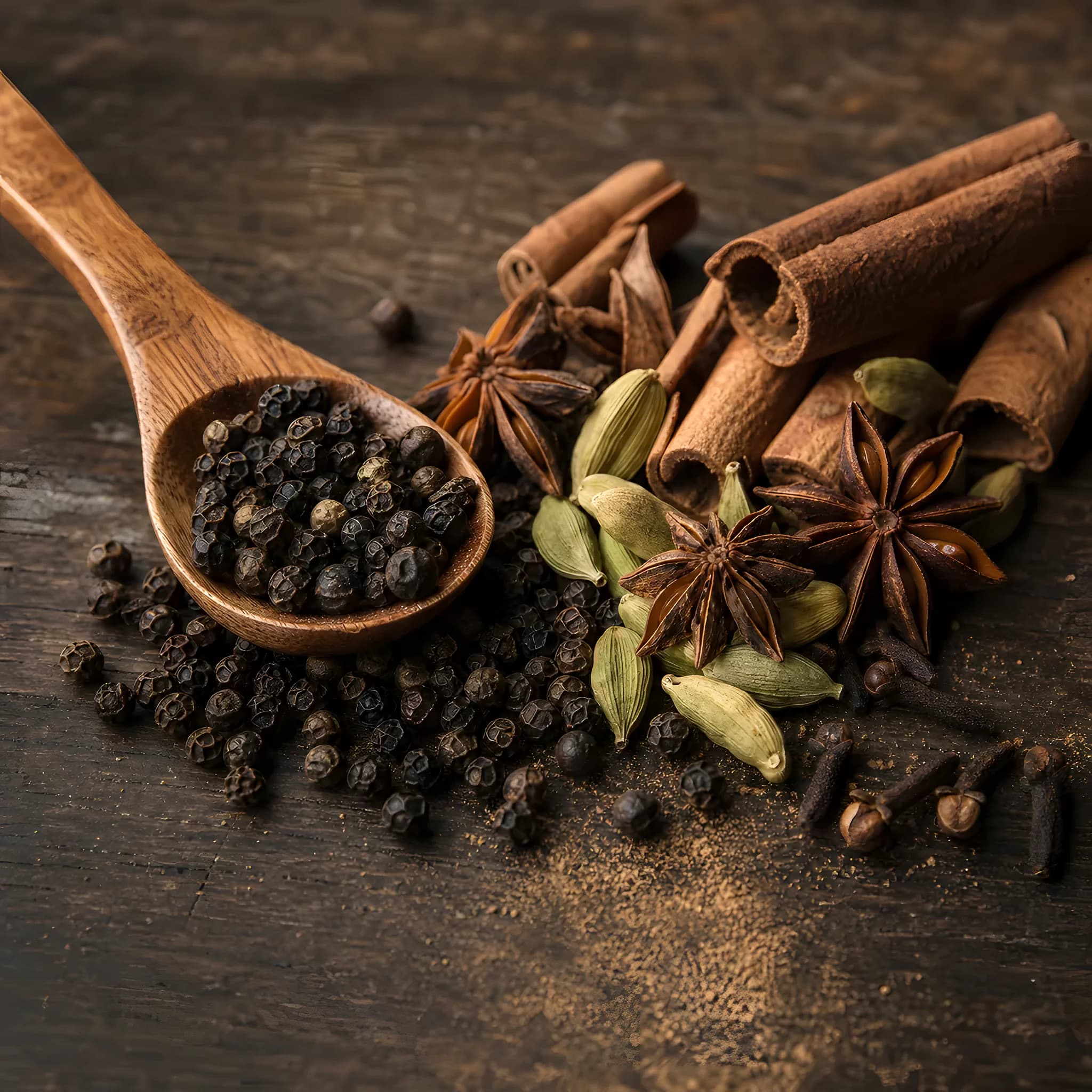
The star anise used as a food spice is Chinese star anise, Illicium verum. Malaysia's Food Regulations 1985 define star anise as "the dried, ripe fruit of the plant Illicium verum" (text updated until August 2026), and the US lists "Illicium verum Hook. f." among spices generally recognised as safe for their intended use in 21 CFR 182.10 (eCFR version of 6 October 2026). This guide focuses on Japanese star anise, Illicium anisatum, which is named in the FDA's 2003 advisory and Malaysia's regulation 330. In 2003 the US Food and Drug Administration (FDA) said Japanese star anise "should be used for decorative purposes only" and that in its dried or processed form it "cannot be distinguished from Chinese star anise through visual examination". This guide sets out what each authority said and when, how rules name the spice, how it appears on labels, and what to ask a supplier.
What Are Chinese and Japanese Star Anise?
In a 2002 import decision, the European Commission described star anise (Illicium verum) as "also known as Chinese star anise or Chinese badian" and "fit for human consumption". The same decision described Japanese star anise as "Illicium anisatum, also known as Illicium religiosum, Illicium japonicum, shikimmi and skimmi" and as "scientifically recognised as highly poisonous and is therefore not fit for human consumption".
Health Canada put it this way in a 2004 advisory: "There is more than one type of star anise." It said Chinese star anise "has a long history of safe use in foods", while other species, "such as Japanese star anise, are used for decorative and aromatic purposes but are not considered safe for human consumption and can be toxic if enough is ingested".
Japan's Ministry of Health, Labour and Welfare, in a 2010 notice, glossed 八角 (hakkaku) as Chinese star anise, also called 大茴香 or 八角茴香, and シキミ (shikimi) as Japanese star anise (our translation). The Singapore Food Agency lists Illicium verum as "Star anise fruit", 八角茴香/大茴香, with the fruit as the part commonly used in food (list as at November 2025). In the Malay text of Malaysia's Food Regulations 1985, the regulation on star anise is headed "Bunga lawang".
What Have Regulators Said About Substitution?
United States, 2003. On 10 September 2003 the FDA advised consumers not to consume "teas" brewed from star anise, after such teas were associated with illnesses affecting about 40 individuals, including approximately 15 infants. The FDA said it had not yet identified the specific type of star anise involved. It was concerned that Chinese star anise, which it considered generally recognised as safe, "may contain Japanese star anise (Illicium anisatum)", which it said "has long been recognized as toxic in many countries". It stated: "FDA considers Chinese star anise to be GRAS when used as a spice or flavoring; Japanese star anise is not GRAS." It also said it would monitor star anise imports "to ensure that any imports of Japanese star anise are not labeled or otherwise indicated for use as a food". The advice concerned tea brewed from star anise. The FDA's enforcement archive page on the advisory carries the date 2 March 2016.
Canada, 2004. On 29 June 2004 Health Canada advised consumers, as a precautionary measure, not to ingest herbal teas or health products containing star anise "unless they are confident that it is Chinese star anise (Illicium verum Hook. f)". For health products, it said it was "requesting evidence from the manufacturers of these products to show that the star anise ingredient is the correct variety (Chinese star anise)". As of 29 June 2004, Health Canada said there had been no reports of adverse reactions in Canada associated with products containing star anise, nor evidence that foods or health products sold in Canada contained toxic varieties of star anise.
European Union, 2002 to 2003. Commission Decision 2002/75/EC of 1 February 2002 recorded that analyses of consignments "from certain third countries have revealed also the presence of Japanese star anise", which had "been linked to some cases of food poisoning in the Community". Article 1 said Member States "may allow imports" of star anise falling within CN code 0909 10 00 from third countries, for human consumption or use as an ingredient in foodstuffs, "provided that" each consignment was accompanied by an official sampling and analysis report and by an Annex I certificate, completed, signed and verified by the exporting country's competent authorities, "demonstrating that the consignment does not contain Japanese star anise"; was imported through a point of entry listed in Annex II; and was identified with a code corresponding to the code on the certificate and the report. Article 2 said Member States "may allow imports of Japanese star anise only if it is intended for use other than human consumption" and required each imported consignment to bear a label stating that the product was not fit for human consumption. Decision 2003/602/EC repealed these conditions on 12 August 2003, stating that the checks "have not revealed any new cases of contamination, and no cases of poisoning have been reported".
Japan, 2010. A notice of 30 November 2010 from the Ministry of Health, Labour and Welfare's Office of Import Food Safety to quarantine station heads reported information that shikimi, which carries a high risk of causing food poisoning, was being mixed into star anise and sold as star anise (our translation). When an import notification was made for star anise or foods containing it, the notice asked stations to guide the importer to confirm whether shikimi was mixed in and, where mixing was found, to hold the cargo and report to the issuing office through the Quarantine Station Operations Management Office (our translation). We did not check whether this instruction is still applied.
How Do Food Rules Name Star Anise?
Malaysia names the species and the look-alike in one regulation. Regulation 330 of the Food Regulations 1985, in the Ministry of Health's English text updated until August 2026 (P.U. (A) 48/2026), reads: "Star anise shall be the dried, ripe fruit of the plant Illicium verum. It shall have the characteristic appearance and shall be free from admixture by Illicium anisatum". Its definition of spice in regulation 286(1) includes plant parts "from which the oil or other flavouring constituent naturally present has not been removed", and says "Spice may be dried or ground or both".
In the US, 21 CFR 182.10 lists both "Anise, star" and "Star anise" against the botanical name "Illicium verum Hook. f." (eCFR, 6 October 2026). The definition of spice in 21 CFR 101.22(a)(2) includes that it is "true to name", and its list of examples spells the spice "Star aniseed".
Singapore's list of Chinese medicinal materials commonly used in food, established by the Agri-Food and Veterinary Authority and the Health Sciences Authority, is described as a guide "on the list of traditional Chinese medicinal materials that are allowed in food". It "is applicable to the use of whole herbs or whole extracts in food and not applicable to the use of isolates or concentrates of the active components from the herbs in food". Star anise, Illicium verum, is item 33, dated 31 August 2004 in the list's "Date of Ascension" column.
How Does Star Anise Appear on Food Labels?
On US labels, 21 CFR 101.22(h)(1) states that spice may be declared as "spice" in the statement of ingredients (eCFR, 6 October 2026). In the EU, Annex VII Part B of Regulation (EU) No 1169/2011 (consolidated text of 1 April 2025) allows "All spices not exceeding 2 % by weight of the food" that are constituents of another food to be designated "Spice(s)" or "mixed spices", without prejudice to Article 21.
Because these provisions allow category names within their stated conditions, a finished-product label might not name the star anise at all. For that reason, ask the supplier to state the species on the specification and on each lot's certificate of analysis.
What Should You Ask a Star Anise Supplier?
- Species on the certificate. Ask for the botanical name, Illicium verum Hook. f., on the specification and on each lot's certificate of analysis, not only the trade name star anise. For Malaysia, ask the supplier to confirm the lot meets regulation 330, including freedom from admixture by Illicium anisatum.
- Identity testing. The FDA said in 2003 that dried or processed Japanese star anise cannot be told apart from Chinese star anise by looking at it. Ask what test the supplier uses to confirm species, whether it runs on every lot, who performs it, and whether it covers ground product as well as whole fruit.
- Country of origin. Ask for the country where the fruit was grown and the country it was packed or ground in. The EU's 2002 decision relied on certificates from the exporting country's authorities, and Japan's 2010 notice identified the country where mixing and sale had reportedly occurred.
- Market documents. Ask which rules the supplier's documents are written against: regulation 330 for Malaysia, 21 CFR 182.10 and the "true to name" condition in 21 CFR 101.22(a)(2) for the US.
- Teas, infusions and health products. If star anise goes into a tea or an infusion, note that the FDA's 2003 advice and Health Canada's 2004 advice both concerned teas, and that Health Canada asked health product manufacturers for evidence that the ingredient was Chinese star anise. Ask for the same evidence.
- Decorative stock. Ask whether the supplier also handles star anise sold for decoration, and how that stock is kept apart from food lots.
Is Japanese Star Anise Permitted in Food?
The texts we read treat it as unfit for food. The FDA stated in 2003 that "Japanese star anise is not GRAS". Malaysia's regulation 330 (updated until August 2026) says star anise "shall be free from admixture by Illicium anisatum". The EU's 2002 import decision called Japanese star anise "not fit for human consumption"; that decision was repealed in 2003.
Does the EU Still Have a Star Anise Import Certificate?
The certificate and point-of-entry conditions were set by Commission Decision 2002/75/EC. Commission Decision 2003/602/EC repealed that decision on 12 August 2003, after checks under it "have not revealed any new cases of contamination, and no cases of poisoning have been reported".
What Is Bunga Lawang?
Bunga lawang is the Malay heading of regulation 330 in Malaysia's Food Regulations 1985 (Malay text updated until August 2026), the regulation whose English text is headed "Star anise". It defines the spice as the dried ripe fruit of Illicium verum.
Is Star Anise the Same as Anise?
No. Health Canada called anise (Pimpinella anisum) "an unrelated herb" in its 2004 star anise advisory. 21 CFR 182.10 lists "Anise" as Pimpinella anisum L. and star anise as Illicium verum Hook. f., and Malaysia's regulation 287 defines aniseed as "the dried, ripe fruit of the plant Pimpinella anisum".
Sources
- FDA, FDA Issues Advisory on Star Anise Teas, FDA News P03-67 (10 September 2003), archived copy of the FDA page captured on 13 May 2009
- FDA, Enforcement Story Archive, "Center for Food Safety and Applied Nutrition 2003", star anise advisory (content current as of 2 March 2016)
- United States, 21 CFR 182.10, spices generally recognised as safe (eCFR, version of 6 October 2026)
- United States, 21 CFR 101.22, paragraphs (a)(2) and (h)(1), spices on food labels (eCFR, version of 6 October 2026)
- Health Canada, News Release 2004-37, advisory on teas and health products containing star anise (29 June 2004)
- Commission Decision 2002/75/EC laying down special conditions on the import from third countries of star anise (1 February 2002)
- Commission Decision 2003/602/EC repealing Decision 2002/75/EC (12 August 2003)
- Regulation (EU) No 1169/2011 on the provision of food information to consumers, Annex VII Part B (consolidated text 01.04.2025)
- Malaysia, Ministry of Health, Food Regulations 1985, regulations 286, 287 and 330 (English text updated until August 2026)
- Malaysia, Kementerian Kesihatan, Peraturan-Peraturan Makanan 1985, peraturan 330 Bunga lawang (Malay text updated until August 2026)
- Japan, Ministry of Health, Labour and Welfare, notice on star anise and foods containing it, 30 November 2010 (in Japanese)
- Singapore Food Agency, List of Chinese Medicinal Materials Commonly Used in Food (as at November 2025)