Among the regulations read for this guide, Malaysia's Food Regulations 1985 and Indonesia's food category regulation are the two that define pineapple juice by name, and Indonesia also defines pineapple juice concentrate. Fresh pineapple is defined in standards: the Codex standard, the ASEAN standard and the Philippine standard. None of the regulations read has an entry for canned pineapple by name; Malaysia and Indonesia have general entries for canned or packaged fruit. Thailand's community product standard named น้ำสับปะรดเข้มข้น carries the English title "PINEAPPLE SYRUP". The defined product has added sugar (our translation). Other entries naming pineapple are not covered here. BPOM includes fruit bars and nastar cookies filled with pineapple jam or another food (our translation). Other exclusions are Thai community standards for other pineapple products and the Philippine standards for pineapple pesticide residue limits and pineapple fibre.
What Do the Standards Say Fresh Pineapple Is?
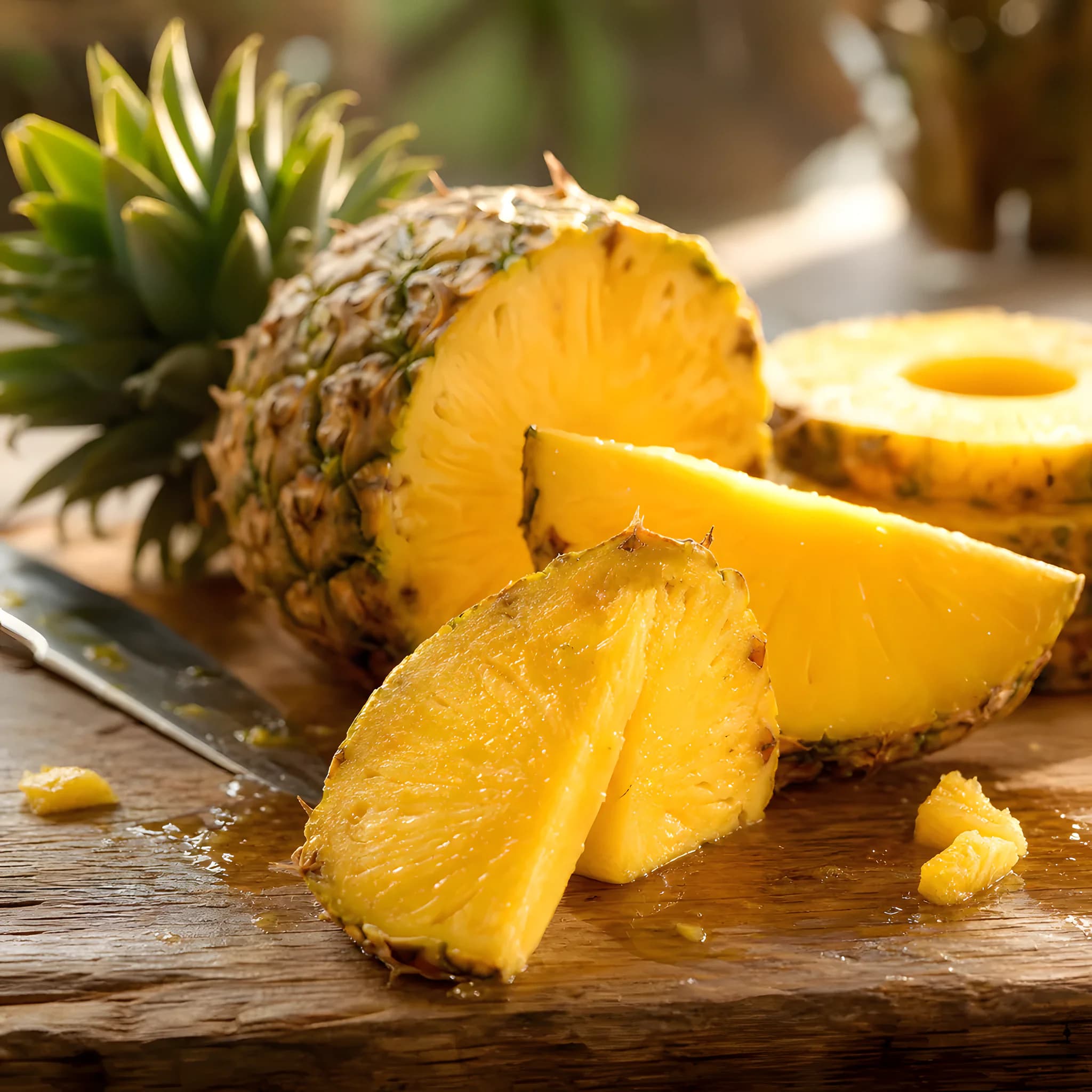
The Codex Standard for Pineapples (CODEX STAN 182-1993, revised 1999, amended 2005 and 2011) "applies to commercial varieties of pineapples grown from Ananas comosus (L.) Merr., of the Bromeliaceae family, to be supplied fresh to the consumer, after preparation and packaging. Pineapples for industrial processing are excluded." The Philippine standard PNS/BAFS 09:2023 uses the same words in its scope. The ASEAN Standard for Pineapple (ASEAN Stan 3:2006, REV, 1-2012) covers pineapples "grown from Ananas comosus L. Merr. of the Bromeliaceae family, to be supplied fresh to the consumer", and also excludes pineapples for industrial processing.
All three say the total soluble solids content in the fruit flesh should be at least 12°Brix, and all three sort pineapples into three classes: Extra Class, Class I and Class II. Codex uses size codes A to H, with separate average weights for fruit with and without crowns. ASEAN and the Philippine standard share a table of codes 1 to 8 for fruit with crowns, although ASEAN uses average weight and the Philippine standard uses individual weight. The Philippine table is optional; trade-practice sizing requires the size and method on the label. For small varieties such as Queen, Philippine clause 6.3 treats code 5 as code 1 and code 8 as code 4. Count-per-box provisions are not described here. A size code therefore needs its standard named.
For non-retail containers, Codex and ASEAN specify exporter, packer and/or dispatcher identification, country of origin, class and size. The produce name is required when the contents are not visible; crown absence should be indicated. Identification code, variety or commercial type, additional origin details, number of units, net weight and official inspection mark are optional. Both allow particulars in accompanying documents. The Philippine standard lists country of origin, class, size if sized, and harvest and packaging dates when required for product safety or integrity; lot number and official control mark are optional. None of the three says whether it is mandatory. Their minimum requirements, class defect limits, tolerances, maturity index, presentation and packaging, consumer-package labelling, food additive, contaminant, hygiene and method clauses are not covered here.
The Malaysian Food Regulations 1985 text read for this guide contains no entry specifically named fresh pineapple. Its general regulation 225 reads: "Raw fruit or fresh fruit shall be the fruit that is not dried, pulped, dehydrated, frozen, canned, candied or pickled. It shall not be withered, shrivelled or discoloured." It may contain permitted colouring substances used in grading or identifying raw fruit as specified in subregulation 21(5), and edible food grade wax may be used in cleaning and preparing raw fruit for sale.
How Does Malaysia Define Pineapple Juice?
Regulation 242 of the Food Regulations 1985 (English text updated until August 2026) reads: "Pineapple juice shall be the fruit juice of mature pineapple of the species Ananas comosus. It shall contain not less than 8 g of soluble solids in 100 ml", measured at 20°C.
Regulation 235(1) brings regulations 236 to 242 within fruit juice: "Fruit juice shall be the expressed juice, or the reconstituted product of concentrated juice and potable water, of one or more species of fruits and includes the food for which a standard is prescribed in regulations 236 to 242. It may contain sugar." Regulation 235(2) sets the acidity of fruit juice, calculated as anhydrous citric acid, at not more than 3.5 per cent w/v "unless otherwise prescribed for a particular type of fruit juice"; regulation 242 prescribes no acidity. Fruit juice "may contain permitted preservative, permitted flavouring substance and ascorbic acid as permitted food conditioner"; regulation 235(6) limits where that flavouring may come from, which this guide does not describe.
Labels under regulation 243 must name the fruit; a juice of more than one fruit carries the words "mixed fruit juice" and the juices present in descending order of proportion. Where sugar has been added, the label carries the words "contains added sugar" or words to the same or similar effect.
Malaysia also names pineapple in its fruit nectar regulation 243A: the minimum fruit ingredient is 30 per cent for pineapple nectar, "fruit ingredient" means fruit pulp free from seeds and skin, and total soluble solids must be not less than 12 per cent. The rest of regulation 243A, including the nectar definition and the rules on combined nectars, additives and labelling, is not covered here.
What Does Indonesia's Food Category Regulation Say?
BPOM Regulation 13 of 2023 on Food Categories, category 14.1.2.1, defines sari buah nanas (pineapple juice) as a fruit juice product obtained from ripe pineapple fruit (Ananas comocsus L Merril, Ananas sativus L Lindii, as printed), without fermentation and physically preserved, which can also be obtained by reconstituting pineapple juice concentrate. Its basic characteristics are total solids of not less than 10 per cent, or not less than 13.5 per cent if the juice is obtained from fruit juice solids diluted with water (our translation). The category's general fruit juice text describes production steps that this guide does not describe. The general entry's ethanol condition and permissions for added concentrate and sugar are also outside this guide's scope.
Lampiran II of the same regulation lists Nanas, Ananas comosus, among raw materials of plant origin without restriction of use, with the fruit as the part that may be used (our translation).
What Counts as Pineapple Juice Concentrate?
Malaysia. Regulation 235(4) reads: "Concentrated fruit juice or fruit juice concentrate shall be the expressed juice of one of more species of fruit, concentrated to the extent that the product has a soluble solid content of not less than double the content of the original juice and may be filtered or unfiltered." ("one of more" as printed.) A package of concentrated fruit juice must give directions for dilution to a juice of approximately the prescribed standard, and the word "concentrate" or "concentrated" may appear only conjoined, in uniform lettering of not less than 10 point, with the words "fruit juice".
Singapore. Regulation 172 of the Food Regulations (current version as at 12 October 2026) reads: "Concentrated fruit juice shall be fruit juice which has been reduced by the removal of water to a volume not exceeding 50% of its original volume with or without the addition of ascorbic acid and permitted colouring matter." Under regulation 171(2), fruit juice made by diluting concentrated fruit juice is made by adding water equal to the volume originally removed in making the concentrate, and under regulation 171(3) it "shall be so indicated on the label in letters not less than 3 mm in height."
Indonesia. BPOM defines konsentrat sari buah nanas (pineapple juice concentrate) as an unfermented fruit product, which may ferment after reconstitution, physically preserved (excluding ionising radiation), obtained by removing water until total solids are not less than 40 per cent measured with a refractometer at 20°C. It may contain added fruit juice, concentrate or water suitable for keeping the concentrate's essential composition and quality factors, and volatile components of pineapple juice. Juice reconstituted from it has the same basic characteristics as pineapple juice. The general concentrate text in category 14.1.2.3 requires solids at least 50 per cent greater than those of the original juice (our translation). The general text also permits the original juice to be with or without added sugar (our translation). The entry's description of the raw material and how it is obtained is not described here.
What Does Thailand's Community Standard Call Pineapple Syrup?
The Thai Industrial Standards Institute's community product standard มผช.1475/2557 is titled น้ำสับปะรดเข้มข้น in Thai and "PINEAPPLE SYRUP" in English. It defines a drink made from pineapple, Ananas comosus (L.) Merr. as printed, with sugar added in a sufficient quantity to make it concentrated, which must be diluted before consumption. Soluble solids must be not less than 60 degrees Brix, and synthetic colours and all preservatives are prohibited (our translation).
A companion standard, มผช.126/2557, "PINEAPPLE DRINK", has two types: น้ำสับปะรดแท้ "(pineapple juice)" and น้ำสับปะรดปรุง "(pineapple drink)". The second must contain not less than 20 per cent by weight of น้ำสับปะรดแท้, and synthetic colours and all preservatives are prohibited in both types (our translation). Both definitions otherwise describe production steps, not described here. Neither standard says it is mandatory. Both standards also state that sugar substitutes, if used, must comply with the types and quantities prescribed by law (our translation). The standards' packaging, net-volume and labelling provisions are not described here. The Institute's list also includes "INSTANT PINEAPPLE" (1526/2562), "NATA DE PINEA PRODUCTS" (1008/2548) and "FERMENTED FISH WITH PINEAPPLE, KHEM MARK NUT" (148/2557), which are not covered here.
How Do Singapore and the Food Standards Code Treat Pineapple Juice?
Neither names pineapple in the provisions read. Singapore's regulation 171(1) reads: "Fruit juice shall be the unfermented liquid extracted from sound, ripe, fresh fruit, with or without sugar, dextrose, invert sugar, liquid glucose, permitted colouring matter, chemical preservatives and ascorbic acid." Its regulations 173 to 175, on nectar, fruit juice cordials, squashes or syrups, and fruit drinks or fruit crushes, are not covered here.
In the Australia New Zealand Food Standards Code, Standard 1.1.2 (compilation 21, in force 9 June 2026) defines fruit juice as "juice made from a fruit", and juice as the liquid portion, with or without pulp, obtained from a fruit or a vegetable, which "includes a product that results from concentrating juice and then reconstituting it with water." Standard 2.6.1, whose as-made text remains current as at 12 October 2026, requires food sold as fruit juice or as the juice of specified fruits to be fruit juice or a blend of fruit juices. It permits additional ingredients: sugars at no more than 40 g/kg, salt, and herbs and spices.
Is There a Legal Name for Canned Pineapple?
Not in the regulations read. Malaysia's regulation 233 reads: "Canned fruit shall be the sound fruit of one type, packed in clean containers that are hermetically sealed processed by heat. Canned fruit may contain sugar, invert sugar, refiner’s syrup, glucose or dried glucose syrup and potable water. The fruit so contained shall be of similar varietal characteristics and of reasonably uniform size." Canned fruit may contain permitted food conditioner.
BPOM's category 04.1.2.4 defines buah dalam kemasan (packaged fruit) as one or more types of clean fruit, whole or in pieces, in a suitable medium such as water, a mixture of water and fruit juice, or fruit juice, with or without added sugar, hermetically packed and processed by pasteurisation or sterilisation. The type name refers to the fruit used, and drained weight must be not less than 40 per cent (our translation). No Codex text other than the fresh pineapple standard was read for this guide.
How Is Pineapple Classified for Trade?
In the WCO HS nomenclature, 2022 edition, heading 08.04 reads "Dates, figs, pineapples, avocados, guavas, mangoes and mangosteens, fresh or dried.", with subheading 0804.30 "- Pineapples". Chapter 8 Note 2 classifies chilled fruit with the corresponding fresh fruit. Heading 08.11 covers frozen fruit that is uncooked or cooked by steaming or boiling in water, whether or not containing added sugar or other sweetening matter; it has no pineapple-specific subheading.
Heading 20.08 covers fruit "otherwise prepared or preserved, whether or not containing added sugar or other sweetening matter or spirit, not elsewhere specified or included", with subheading 2008.20 "- Pineapples".
Heading 20.09 covers fruit or nut juices "unfermented and not containing added spirit, whether or not containing added sugar or other sweetening matter." Its pineapple juice group splits into 2009.41 "-- Of a Brix value not exceeding 20" and 2009.49 "-- Other"; mixtures of juices go to 2009.90. Chapter 20 Note 6 sets the alcoholic strength of juices that count as unfermented and not containing added spirit at not more than 0.5 % vol; Subheading Note 3 defines Brix value, which this guide does not describe. National tariff schedules and the HS Explanatory Notes were not checked.
What Should You Ask a Pineapple Supplier?
- Market and name. Ask which market's name the product is sold under, and for juice whether it meets that market's entry, such as Malaysia's regulation 242 or BPOM's sari buah nanas.
- Concentrate. Ask which concentrate provision the product meets: Malaysia's regulation 235(4), Singapore's regulation 172, or BPOM's pineapple juice concentrate entry in category 14.1.2.3.
- Syrup or concentrate. For a Thai น้ำสับปะรดเข้มข้น, ask whether sugar has been added, as in the community standard.
- Fresh fruit grade. Ask for class, size code and the standard the size code comes from.
Is Pineapple Juice Made From Concentrate Still Pineapple Juice?
In the Malaysian, Indonesian, Singapore and Food Standards Code texts read, yes, with conditions. Malaysia's fruit juice definition includes the reconstituted product of concentrated juice and potable water. BPOM's pineapple juice entry includes reconstitution of pineapple juice concentrate, with total solids of not less than 13.5 per cent for juice from diluted juice solids (our translation). The Food Standards Code's juice definition includes reconstituted juice. Singapore requires water equal to the volume originally removed, and a label statement in letters not less than 3 mm high.
Which HS Code Covers Pineapple Juice?
For pineapple juice meeting heading 20.09's conditions, the 2022 WCO HS subheadings are 2009.41 for a Brix value not exceeding 20 and 2009.49 for other pineapple juice. Fresh or dried pineapples fall under 0804.30. Pineapples otherwise prepared or preserved fall under 2008.20 when they meet heading 20.08 and are not elsewhere specified or included. National tariff schedules were not checked.
Is Thai Pineapple Syrup the Same as Pineapple Juice Concentrate?
The definitions rest on different bases. Thailand's community standard มผช.1475/2557, น้ำสับปะรดเข้มข้น, carries the English title "PINEAPPLE SYRUP". Its definition describes a drink made concentrated by adding sugar that must be diluted before consumption (our translation). Singapore and BPOM define concentrate by the removal of water, and Malaysia by soluble solids of not less than double those of the original juice.
Do Fresh Pineapple Standards Cover Fruit for Processing?
No. The Codex, ASEAN and Philippine standards each apply to pineapples supplied fresh to the consumer and state that pineapples for industrial processing are excluded.
Sources
- Malaysia, Ministry of Health, Food Regulations 1985, regulations 225, 233, 235, 242, 243 and 243A (English text updated until August 2026)
- Singapore Food Regulations, regulations 171 to 175 (current version as at 12 October 2026)
- Food Standards Australia New Zealand, Australia New Zealand Food Standards Code, Standard 2.6.1 Fruit juice and vegetable juice
- Food Standards Australia New Zealand, Australia New Zealand Food Standards Code, Standard 1.1.2 Definitions used throughout the Code
- Indonesia, BPOM Regulation No. 13 of 2023 on Food Categories, Lampiran I categories 04.1.2.4 and 14.1.2, and Lampiran II (source in Indonesian, our translation)
- Thailand, Thai Industrial Standards Institute, Thai community product standard 126/2557, pineapple drink (source in Thai, our translation)
- Thailand, Thai Industrial Standards Institute, Thai community product standard 1475/2557, pineapple syrup (source in Thai, our translation)
- Philippines, Bureau of Agriculture and Fisheries Standards, PNS/BAFS 09:2023 Pineapples, Product Standard, Grading and Classification (list of approved Philippine National Standards)
- ASEAN Standard for Pineapple (ASEAN Stan 3:2006, REV, 1-2012)
- Codex Alimentarius, Codex Standard for Pineapples (CODEX STAN 182-1993)
- World Customs Organisation, HS nomenclature 2022 edition, Chapter 8
- World Customs Organisation, HS nomenclature 2022 edition, Chapter 20
- Thailand, Thai Industrial Standards Institute, list of Thai Community Product Standards