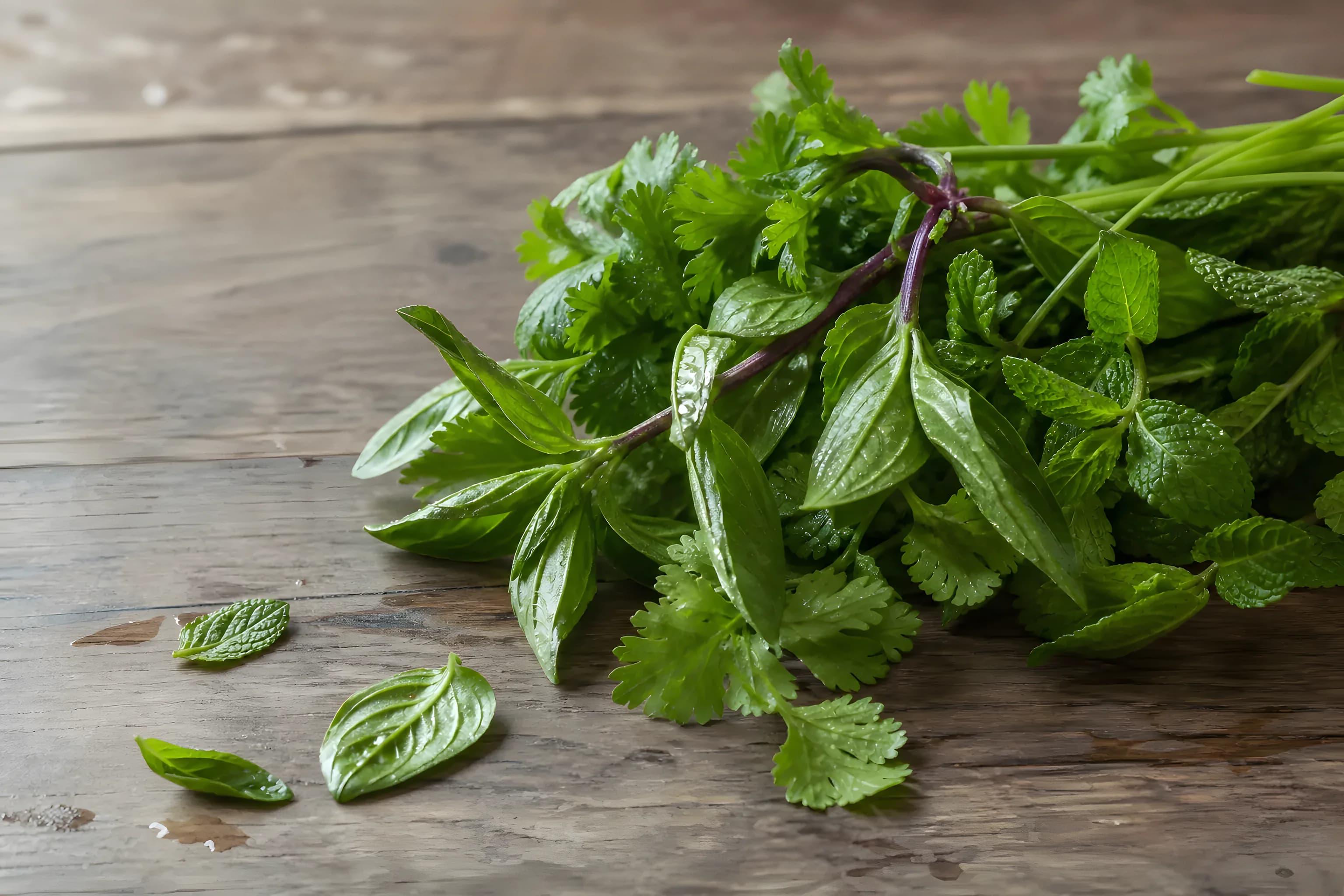
Name the part as well as the plant: the texts read that give a species for coriander leaf and coriander seed name the same one, Coriandrum sativum, but official texts use the word coriander for different parts, and not all of them say which part they mean. Malaysia's Food Regulations 1985 define coriander as "the dried, mature fruit of the plant Coriandrum sativum" (English text updated until August 2026). Schedule 22 of the Australia New Zealand Food Standards Code lists "Coriander (leaves, stems)" among herbs, and "Coriander seed" and "Coriander root" among spices (compilation No. 5, in force on 30 April 2026). This guide covers the species, leaf and seed, the word cilantro, names in six markets, trade codes and standards, ingredient lists and supplier questions.
Which Species Do Official Texts Call Coriander?
Every text read that names a species for plain coriander, cilantro or ketumbar names Coriandrum sativum. The US list of spices in 21 CFR 182.10 prints "Coriander" against "Coriandrum sativum L." (eCFR version of 8 October 2026). Malaysia's regulation 304 names "Coriandrum sativum", and Indonesia's BPOM Regulation 13 of 2023 defines ketumbar as the ripe, dried fruit of the plant Coriandrum sativum Linn (our translation). The Thai dictionary, a language reference rather than a food regulation, defines ชี ๒ as the herbaceous plant Coriandrum sativum L., family Umbelliferae (our translation).
An information document of the Codex Committee on Spices and Culinary Herbs (CCSCH), a layout template for its standards rather than a standard, lists "Coriander Leaf" and "Coriander Seed" as separate rows, both "Coriandrum sativum L.".
A qualifier can change the plant. The US crop group tables in 40 CFR 180.41 list "Coriander, Vietnamese, fresh leaves, Persicaria odorata (Lour.) Sojak" and "Coriander, Bolivian, fresh leaves, Porophyllum ruderale (Jacq.) Cass", plants of other genera. The same tables list "Culantro (leaf)" separately, as Eryngium foetidum.
Is Coriander the Leaf or the Seed?
It depends on the text. Malaysia's regulation 304 says "Coriander shall be the dried, mature fruit of the plant Coriandrum sativum.", and regulation 305 defines coriander powder as "the powder obtained by grinding the clean, dried fruit of Coriandrum sativum". Regulation 286 defines spice as "the sound leaves, flowers, buds, fruits, seeds, barks or rhizomes of plants", among other conditions, but the coriander entry itself covers only the fruit.
Indonesia separates the parts by name. BPOM defines ketumbar as the ripe, dried fruit and daun ketumbar as a herb obtained from the leaves of Coriandrum sativum Linn. (our translation), and lists daun ketumbar among the examples in its herb category. In its list of raw materials without restriction of use, row 175 identifies fruit, leaf and seed as the parts of ketumbar that can be used (our translation).
Schedule 22 places all three entries in the class "Herbs and Spices": "Coriander (leaves, stems)" in the "Herbs" group, and "Coriander seed" and "Coriander root" in the "Spices" group, under "Spices, seeds" and "Spices, root or rhizome" respectively. The Codex template places coriander only in its "Dried seeds" group, while its generic list keeps the leaf and the seed apart. The US crop group tables list "Coriander, fruit" and "Coriander, seed" as separate rows in their spice group.
Note the word used for the spice. Malaysia and BPOM define it as a fruit; the HS nomenclature, Schedule 22 and the Codex template call it a seed.
Where Does the Word Cilantro Appear?
Among the texts read, the US texts use cilantro as a commodity name, and not only for the leaf. 21 CFR 182.10 and the spice examples in 21 CFR 101.22(a)(2) print "Coriander" with no part named. The produce safety rule, 21 CFR 112.1(b)(1), names "herbs (such as basil, chives, cilantro, oregano, and parsley)" in its list of fruits and vegetables that, subject to its exemptions, are covered produce. The crop group tables in 40 CFR 180.41 print "Cilantro, fresh leaves" in the "Leafy Vegetable Group" and "Cilantro, dried leaves" in the "Herb Group", while the "Herbs and Spices Group" prints "Coriander (cilantro or Chinese parsley) (leaf)" and "Coriander (cilantro) (seed)".
The Malaysian, Australian and New Zealand, Codex and Singapore texts read do not use the word cilantro. In a US specification, cilantro alone does not fix the part, so ask which part is meant.
What Is Coriander Called in Each Market?
Malaysia. The Malay text of the Food Regulations 1985 (header "Kemaskini sehingga Ogos 2026") heads regulation 304 "Ketumbar." and regulation 305 "Serbuk ketumbar.", and defines ketumbar as the dried, mature fruit of the plant Coriandrum sativum (our translation).
Indonesia. BPOM's entries are headed "Ketumbar", "Daun Ketumbar" and "Ketumbar Bubuk". Ketumbar alone is the fruit and daun ketumbar the leaf; ground ketumbar is defined as a powder obtained by grinding the cleaned, dried fruit (our translation).
Thailand. In the Thai dictionary, a language reference, ผักชี refers to ชี ๒, which names Coriandrum sativum L., used as a vegetable and called ผักชี, with its fruit used as a spice when mature; it is also called ชีลา or หอมป้อม (our translation). A separate entry, ลูกผักชี, is the name for the fruit of ผักชี, used as a spice (our translation). The dictionary is a national language reference, not a food regulation.
China. The national standards information platform supervised by China's market regulation and standardisation administrations (our translation) lists GB/T 22306-2026 under the Chinese title 胡荽 and the English title "Coriander".
Australia and New Zealand. Schedule 22 uses coriander for the leaves and stems, the seed and the root, and has no entry for cilantro.
United States. The texts read use coriander for the plant and the spice, and cilantro for the leaf and, in one table, the seed, as set out above.
The Singapore provisions read for this guide do not name coriander, so no Singapore name is given.
How Is Coriander Classified for Trade?
In the 2022 edition of the World Customs Organisation (WCO) HS nomenclature, heading 09.09 reads "Seeds of anise, badian, fennel, coriander, cumin or caraway; juniper berries." Under "Seeds of coriander", subheading 0909.21 is "Neither crushed nor ground" and 0909.22 is "Crushed or ground".
The leaf has no named code in the texts read. Note 2 to chapter 7 says the word "vegetables" in headings 07.09 to 07.12 includes, among others, fennel, parsley and chervil; it does not name coriander, and no heading or subheading text in chapters 7 or 9 names coriander leaf. National tariff schedules and the HS Explanatory Notes were not checked, so this guide gives no code for the leaf.
Which Standards Cover Coriander?
ISO 2255:1996 is the ISO specification for "Coriander (Coriandrum sativum L.), whole or ground (powdered)". As read on 12 October 2026, the catalogue entry published by Albania's national standards body shows it published on 18 April 1996 and at the stage "Standard to be revised" since 20 September 2024, with ISO 2255:1980 withdrawn. A separate entry shows the revision project, ISO/AWI 2255, approved on 20 September 2024. We did not read the standard.
As shown on 12 October 2026, the Chinese platform lists GB/T 22306-2026, 胡荽, published on 31 March 2026 and implemented from 1 October 2026, as current, and the 2008 edition of GB/T 22306 as abolished (our translation). The record notes that the standard adopts a standard of an international or foreign organisation, without saying which (our translation). We did not read the text.
How Can Coriander Appear on an Ingredient List?
In the United States, 21 CFR 101.22(a)(2) includes "Coriander" among its examples of spices, and 101.22(h)(1) says spice "may be declared as “spice”" in the statement of ingredients.
In Australia and New Zealand, Standard 1.2.4 (compilation No. 2, in force on 2 September 2025) says that, subject to Division 3 of Standard 1.2.3, a statement of ingredients must identify each ingredient other than offal by a name by which it is commonly known, a name that describes its true nature, or "a generic name for the ingredient that is specified in Schedule 10, in accordance with any conditions specified in that Schedule". Schedule 10 (compilation No. 4, in force on 25 February 2021) lists both "herbs" and "spices" as generic names with no condition for use entered.
In Singapore, regulation 5(4)(b)(i) of the Food Regulations defines the appropriate designation on an ingredient list as a specific name or description indicating the true nature of the ingredient "except as provided in the First Schedule" (current version as at 12 October 2026). The First Schedule lists "Any herb, part of a herb or mixture of herbs not exceeding 2% by weight either singly or in combination in the food" against "Herbs or mixed herbs as applicable", and "Any spice or mixture of spices or spice extracts not exceeding 2% by weight, either singly or in combination in the food" against "Spice, spices or mixed spices as applicable".
In Malaysia, regulation 11(1) applies to every package containing food for sale, unless otherwise provided in the Regulations, and paragraph (e) requires, for food of two or more ingredients other than water, food additives and added nutrient, the appropriate designation of each ingredient in descending order of proportion by weight and, wherever required by the Regulations, a declaration of the proportion of that ingredient. Under regulation 2, the appropriate designation must be a specific, not a generic, name or description that indicates the true nature of the food to the prospective purchaser.
Because the US, Australian and New Zealand, and Singapore provisions allow a category name within their stated conditions, a finished-product label might say spice or herbs and not name coriander at all. Ask for the botanical name and the part on the specification instead.
What Should You Ask a Coriander Supplier?
- Botanical name and part. Ask the supplier to state the botanical name and plant part on the specification. The sources read identify Coriandrum sativum for coriander leaf, fruit or seed; Schedule 22 lists coriander root without giving a botanical name. A trade name alone is not enough: coriander means the fruit in Malaysia's regulation 304, one US table applies cilantro to the seed as well as the leaf, and "Coriander, Vietnamese" and "Coriander, Bolivian" are other plants in the US crop group tables.
- Which definition. Ask which text the lot is sold against, for example Malaysia's regulation 304 or 305, or BPOM's ketumbar, daun ketumbar or ketumbar bubuk entry.
- Form. Ask whether the lot is whole or ground, and fresh or dried, and check the description against the definition cited, such as coriander powder under Malaysia's regulation 305.
- Trade code. For seed, ask for the HS subheading on the shipping documents: 0909.21 for neither crushed nor ground, 0909.22 for crushed or ground. For leaf, ask which heading the supplier uses and on what authority, since the HS texts read do not name it.
- Standards cited. If a specification cites ISO 2255 or GB/T 22306, ask for the edition: ISO 2255:1996 is marked "Standard to be revised", and GB/T 22306 has 2008 and 2026 editions.
Are Coriander and Cilantro the Same Plant?
In the texts read, yes, when no qualifier is added. 40 CFR 180.41 prints "Coriander (cilantro or Chinese parsley) (leaf)" and "Coriander (cilantro) (seed)", both Coriandrum sativum, and 21 CFR 182.10 gives "Coriandrum sativum L." for coriander. Which part each word means varies by text, so ask for the part.
What Does Ketumbar Mean?
In Malaysia's Malay text, "Ketumbar." heads regulation 304, which the English text calls coriander: "the dried, mature fruit of the plant Coriandrum sativum". BPOM Regulation 13 of 2023 defines ketumbar as the ripe, dried fruit of Coriandrum sativum Linn and uses daun ketumbar for the leaf (our translation).
Which HS Code Covers Coriander Seed?
In the 2022 edition of the WCO HS nomenclature, coriander seed falls under heading 09.09, with subheading 0909.21 for "Neither crushed nor ground" and 0909.22 for "Crushed or ground". National tariff schedules were not checked.
Is Vietnamese Coriander the Same Plant as Coriander?
No, not in the text read. The US crop group tables in 40 CFR 180.41 list "Coriander, Vietnamese, fresh leaves" as "Persicaria odorata (Lour.) Sojak", while the same section gives Coriandrum sativum for coriander and cilantro. Ask for the botanical name.
Sources
- United States, 21 CFR 182.10, "Spices and other natural seasonings and flavorings" (eCFR, version of 8 October 2026)
- United States, 21 CFR 101.22, paragraphs (a)(2) and (h)(1), spices on food labels (eCFR, version of 8 October 2026)
- United States, 21 CFR 112.1, paragraph (b)(1), produce covered by the produce safety rule (eCFR, version of 8 October 2026)
- United States, 40 CFR 180.41, "Crop group tables" (eCFR, version of 8 October 2026)
- Malaysia, Ministry of Health, Food Regulations 1985, regulations 2, 11, 286, 304 and 305 (English text updated until August 2026)
- Malaysia, Kementerian Kesihatan, Peraturan-Peraturan Makanan 1985, peraturan 304 and 305 (Malay text, updated until August 2026, our translation of the header)
- Indonesia, BPOM Regulation No. 13 of 2023 on Food Categories (our translation; source in Indonesian)
- Codex Alimentarius, Codex Committee on Spices and Culinary Herbs, information document, standard layout template for spices and culinary herbs standards
- World Customs Organisation, HS nomenclature 2022 edition, Chapter 9
- World Customs Organisation, HS nomenclature 2022 edition, Chapter 7
- ISO 2255:1996, coriander (Coriandrum sativum L.), whole or ground (powdered), specification, catalogue entry published by Albania's national standards body
- ISO/AWI 2255, coriander, revision project, catalogue entry published by Albania's national standards body
- China, national standards platform, GB/T 22306-2026, 胡荽, Coriander (status as shown on 12 October 2026)
- Thailand, dictionary lookup entries ผักชี, ชี and ลูกผักชี (source in Thai)
- Australia New Zealand Food Standards Code, Schedule 22, Foods and classes of foods (compilation No. 5, in force on 30 April 2026)
- Australia New Zealand Food Standards Code, Standard 1.2.4, Information requirements, statement of ingredients (compilation No. 2, in force on 2 September 2025)
- Australia New Zealand Food Standards Code, Schedule 10, Generic names of ingredients and conditions for their use (compilation No. 4, in force on 25 February 2021)
- Singapore, Food Regulations, regulation 5, general requirements for labelling (current version as at 12 October 2026)
- Singapore, Food Regulations, First Schedule, permitted use of generic terms in the declaration of ingredients (current version as at 12 October 2026)