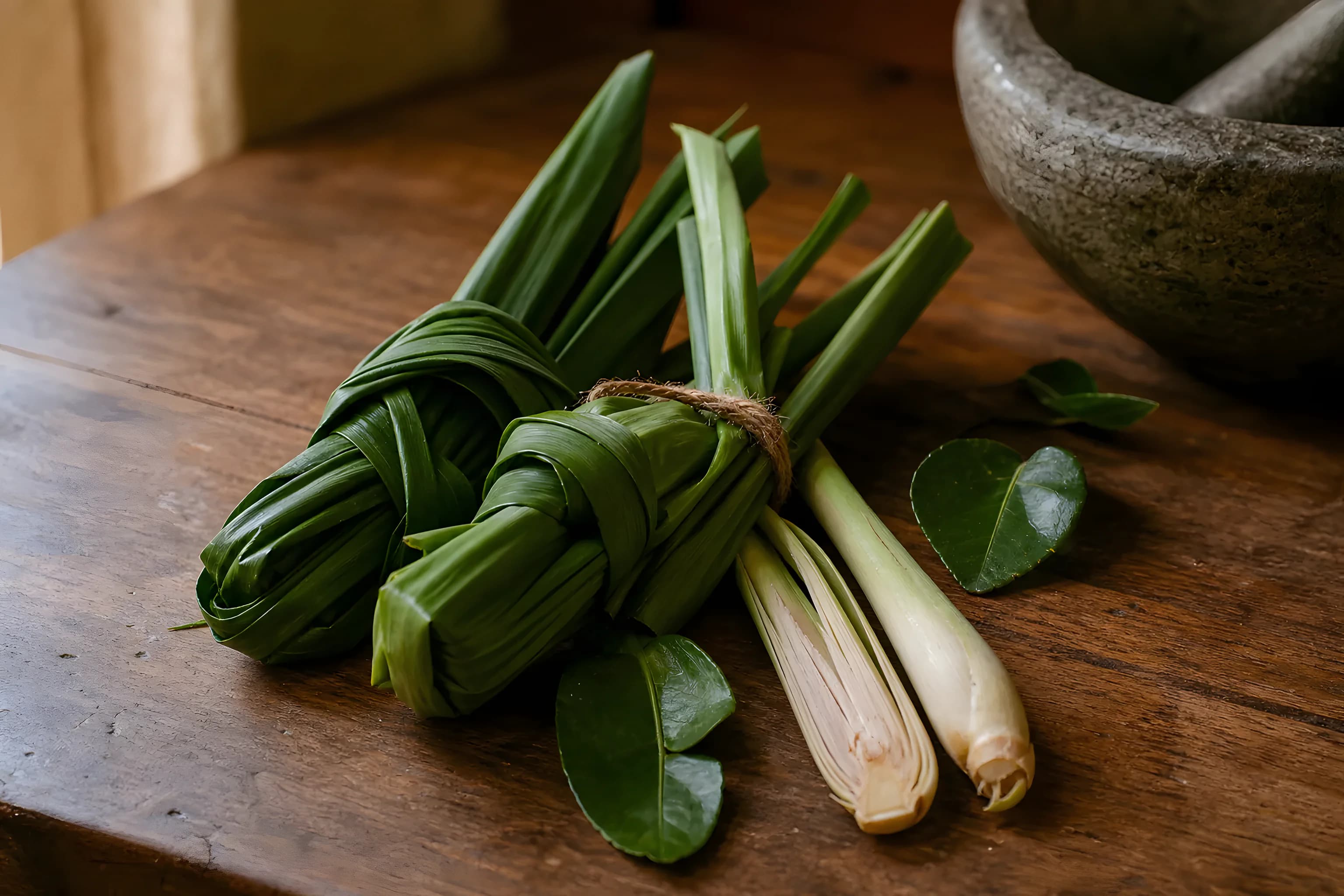
Official texts attach the name lemongrass to more than one Cymbopogon species, so ask the supplier to state the botanical name on the specification alongside the common name. GRIN, the US Department of Agriculture's plant database, records "lemongrass" as an English name for both Cymbopogon citratus (DC.) Stapf and Cymbopogon flexuosus (Nees) Will. Watson. The US list in 21 CFR 182.20 gives two Cymbopogon names against "Lemon grass" (eCFR version of 6 October 2026), while the scope of a draft ISO specification for dried lemongrass names Cymbopogon citratus. Indonesia's herbal pharmacopoeia uses the name sereh for Andropogon nardus (our translation), a name GRIN links to a citronella species. This guide compares the plant names and forms these texts record, explains how lemongrass can appear on labels, and suggests questions for suppliers.
Which Cymbopogon Species Carry the Name Lemongrass?
GRIN places the four species in this guide in genus Cymbopogon, family Poaceae. It lists Cymbopogon citratus (DC.) Stapf under the English names "lemongrass" and "West Indian lemongrass", with Andropogon citratus DC. as its basionym. It lists Cymbopogon flexuosus (Nees) Will. Watson under "lemongrass", "East Indian lemongrass", "Cochin lemongrass", "Malabar lemongrass" and "Malabar grass", with Andropogon flexuosus Nees as its basionym.
Two more species carry citronella names in GRIN. Cymbopogon nardus (L.) Rendle is listed under "citronella", "citronella grass" and "Ceylon citronella", among other names, with Andropogon nardus L. as its basionym. Cymbopogon winterianus Jowitt is listed under "Java citronella" and "Burma citronella".
Names in other languages cross between these groups. GRIN records the French names "citronnelle" and "citronelle" for Cymbopogon citratus, the Spanish "zacate limón" for both Cymbopogon citratus and Cymbopogon nardus, and the French "verveine des Indes" for both Cymbopogon citratus and Cymbopogon flexuosus. A common name on its own may therefore not identify the species.
GRIN's distribution records differ too. For Cymbopogon citratus every country row is marked cultivated or naturalised, with the note "(origin unknown)". For Cymbopogon flexuosus it lists native rows in India, Nepal, Myanmar, Thailand and southern Yunnan in China.
What Do Regulatory and Reference Texts Say About These Names?
United States. 21 CFR 182.20 is headed "Essential oils, oleoresins (solvent-free), and natural extractives (including distillates)" and lists those "generally recognized as safe for their intended use, within the meaning of section 409 of the Act". Its "Lemon grass" row gives "Cymbopogon citratus DC. and Cymbopogon lexuosus Stapf." as the botanical names of the plant source, printed that way in the eCFR text of 6 October 2026; GRIN's record for the second species is spelt Cymbopogon flexuosus. A separate "Citronella" row gives "Cymbopogon nardus Rendle.". The author citations in these rows differ from GRIN's. This guide covers the plant and its names, not the products that section lists.
ISO draft. ISO/FDIS 25261 is a draft International Standard owned by ISO/TC 34/SC 7, titled as a specification for whole, cut and ground lemongrass. Its scope reads: "This International Standard specifies the requirements for dried lemon grass leaves (Cymbopogon citratus L.) in whole or ground form intended for human consumption." The scope gives the author as "L.", where GRIN gives (DC.) Stapf. The Institute for Standardization of Serbia's project page records stage 50.00, "Final text received or FDIS registered for formal approval", from 16 September 2026. At that stage it was a draft, and we have not read its text.
Indonesia. Farmakope Herbal Indonesia, second edition (2017), from the Ministry of Health, has a monograph headed "DAUN SEREH", Latin title "Andropogonis Nardi Folium", which defines sereh leaf as the leaf of Andropogon nardus Linn., family Poaceae (our translation). GRIN gives Andropogon nardus L. as the basionym of Cymbopogon nardus (L.) Rendle, the species it lists under citronella names. The pharmacopoeia's foreword describes it as a standard in the field of pharmacy, mainly for raw materials of traditional medicine (our translation). It is used here as a naming reference, not as food law. A document that uses the name sereh could therefore point to a different species from Cymbopogon citratus.
Malaysia. In our searches of the English and Malay texts of the Food Regulations 1985 (updated until August 2026, P.U. (A) 48/2026), neither text contained "Cymbopogon" or "Andropogon", and the English text contained no occurrence of "lemon grass", "lemongrass" or "lemon-grass". The general definition of spice in regulation 286(1) includes leaves, subject to the conditions in that definition: the plant parts must be sound, suitable for use as condiments for imparting flavour or aroma to food, and must not have had their naturally present oil or other flavouring constituent removed. It also says "Spice may be dried or ground or both".
Which Plant Parts and Forms Do the Texts Describe?
The draft ISO text is titled for whole, cut and ground lemongrass, and its scope covers dried leaves "in whole or ground form". The Indonesian monograph describes sereh leaf as long flat pieces (our translation). Where lemongrass is sold as a spice in the US, the definition of spice in 21 CFR 101.22(a)(2) covers "any aromatic vegetable substance in the whole, broken, or ground form" that is, among other conditions, "true to name". Malaysia's regulation 286(1) says spice "may be dried or ground or both".
How Does Lemongrass Appear on Food Labels?
Where lemongrass is used as a spice in a US food, 21 CFR 101.22(h)(1) states that spice may be declared as "spice" in the statement of ingredients (eCFR, 6 October 2026). In the EU, Annex VII Part B of Regulation (EU) No 1169/2011 (consolidated text of 1 April 2025) allows ingredients that belong to one of its listed categories and are constituents of another food to be designated by the category name rather than their specific name, without prejudice to Article 21. The category for "All spices not exceeding 2 % by weight of the food" is "Spice(s)" or "mixed spices", and for "All herbs or parts of herbs not exceeding 2 % by weight of the food" it is "Herb(s)" or "mixed herbs". Part B names no individual spice or herb.
Because these provisions allow category names within their stated conditions, a finished-product label might not name lemongrass, let alone the species. For that reason, ask the supplier to state the species on the specification and on each lot's certificate of analysis.
What Should You Ask a Lemongrass Supplier?
- Botanical name with author. Ask for the full name, such as Cymbopogon citratus (DC.) Stapf or Cymbopogon flexuosus (Nees) Will. Watson, on the specification and on each lot's certificate of analysis, not only "lemongrass". GRIN records "lemongrass" for both species, and the draft ISO scope names Cymbopogon citratus.
- Citronella names. If a document names Cymbopogon nardus or Cymbopogon winterianus, or uses a citronella name, ask the supplier to confirm which species is supplied. GRIN lists these two species under citronella names, apart from the lemongrass species.
- Andropogon names and sereh. If a document uses Andropogon citratus, Andropogon flexuosus or Andropogon nardus, or the name sereh, ask for the corresponding Cymbopogon name. GRIN gives each of those Andropogon names as the basionym of one Cymbopogon species, and Indonesia's herbal pharmacopoeia defines sereh leaf as the leaf of Andropogon nardus Linn. (our translation).
- Part and form. Ask which plant part is supplied, whether it is whole, cut or ground, and whether it is dried. The draft ISO text covers dried leaves and is titled for whole, cut and ground lemongrass; the US spice definition covers the "whole, broken, or ground form"; Malaysia's says spice "may be dried or ground or both".
- Identity on every lot. Ask how the supplier confirms species for each lot, who performs the check, and whether it covers ground product as well as whole or cut leaves.
- Country of origin. Ask the supplier to state the country of origin.
- Market documents. Ask which regulatory texts, standards or drafts the documents refer to: for example 21 CFR 101.22(a)(2) and its "true to name" condition where lemongrass is sold as a spice in the US, regulation 286 for Malaysia, and ISO/FDIS 25261, which was a draft at the stage recorded on 16 September 2026.
Is Citronella the Same Plant as Lemongrass?
Not in GRIN's records. GRIN lists citronella names under Cymbopogon nardus (L.) Rendle and Cymbopogon winterianus Jowitt, and lemongrass names under Cymbopogon citratus (DC.) Stapf and Cymbopogon flexuosus (Nees) Will. Watson. 21 CFR 182.20 also has separate "Citronella" and "Lemon grass" rows (eCFR version of 6 October 2026).
Which Species Does the US List Give for Lemon Grass?
The "Lemon grass" row of 21 CFR 182.20 gives "Cymbopogon citratus DC. and Cymbopogon lexuosus Stapf." as printed in the eCFR text of 6 October 2026. GRIN spells the second epithet flexuosus. The column holding these names is headed "Botanical name of plant source".
What Is Daun Sereh in Indonesia's Herbal Pharmacopoeia?
In Farmakope Herbal Indonesia, second edition (2017), daun sereh is the leaf of Andropogon nardus Linn., family Poaceae (our translation). GRIN gives Andropogon nardus L. as the basionym of Cymbopogon nardus (L.) Rendle, which it lists under citronella names.
Is There an ISO Standard for Dried Lemongrass?
A draft. ISO/FDIS 25261 covers "dried lemon grass leaves (Cymbopogon citratus L.) in whole or ground form intended for human consumption". The Institute for Standardization of Serbia's project page records stage 50.00, "Final text received or FDIS registered for formal approval", dated 16 September 2026.
Sources
- United States, 21 CFR 182.20, Essential oils, oleoresins (solvent-free), and natural extractives (including distillates) (eCFR, version of 6 October 2026)
- United States, 21 CFR 101.22, paragraphs (a)(2) and (h)(1), spices on food labels (eCFR, version of 6 October 2026)
- USDA Agricultural Research Service, GRIN Taxonomy, Cymbopogon citratus (DC.) Stapf (accessed 11 October 2026)
- USDA Agricultural Research Service, GRIN Taxonomy, Cymbopogon flexuosus (Nees) Will. Watson (accessed 11 October 2026)
- USDA Agricultural Research Service, GRIN Taxonomy, Cymbopogon nardus (L.) Rendle (accessed 11 October 2026)
- USDA Agricultural Research Service, GRIN Taxonomy, Cymbopogon winterianus Jowitt (accessed 11 October 2026)
- Institute for Standardization of Serbia, project page for ISO/FDIS 25261, whole, cut and ground lemongrass specification (stage dated 16 September 2026)
- Indonesia, Kementerian Kesehatan, Farmakope Herbal Indonesia Edisi II (2017), monograph Daun Sereh (in Indonesian)
- Malaysia, Ministry of Health, Food Regulations 1985, regulation 286 (English text updated until August 2026)
- Malaysia, Kementerian Kesihatan, Peraturan-Peraturan Makanan 1985 (Malay text updated until August 2026)
- Regulation (EU) No 1169/2011 on the provision of food information to consumers, Annex VII Part B (consolidated text 01.04.2025)