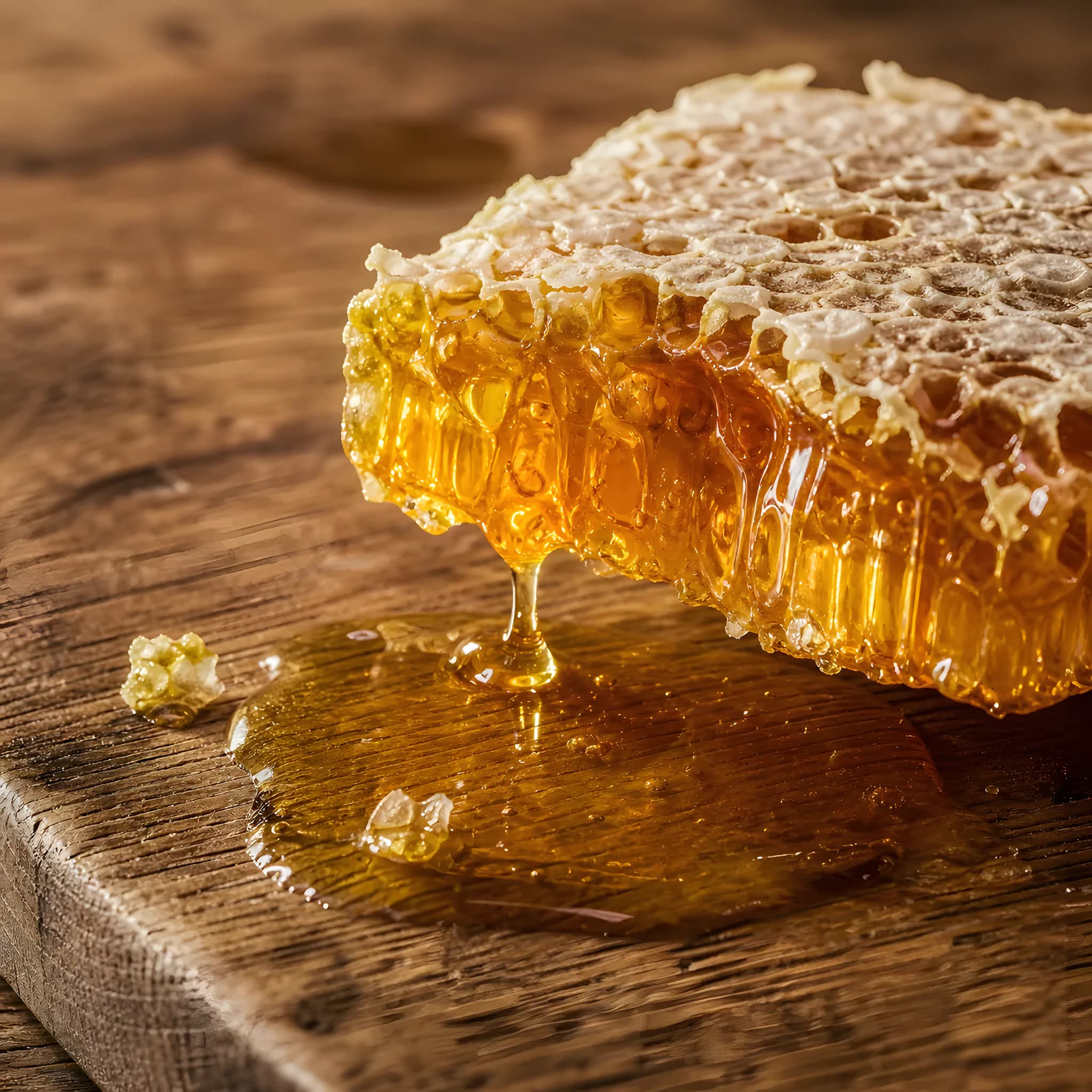
Check which market's definition a honey contract is written against, because the official texts read do not set the same conditions. Malaysia's Food Regulations 1985 say honey shall not contain more than "20 per cent of water". The Australia New Zealand Food Standards Code requires a food sold as honey to contain "no more than 21% moisture", and Thailand's honey notification sets moisture at not more than 21 per cent by weight (our translation). The Philippine standard allows "not more than 23%" for wild honey and "not more than 20%" for other honeys. This guide sets out the legal definitions, the compositional conditions from each official text, what may be added, label rules, the HS heading and supplier questions. Stingless bee honey has separate entries: Malaysia's regulation 130A covers kelulut honey, and Standard 1.1.2 of the Food Standards Code defines native bee honey. This guide does not cover them.
How Do Official Texts Define Honey?
Malaysia. Regulation 130(1) of the Food Regulations 1985 (English text updated until August 2026) reads: "Honey shall be the sugary product obtained from the comb of the honey bee."
Australia and New Zealand. Standard 1.1.2 of the Food Standards Code (compilation 21, in force 9 June 2026) defines honey as "the natural sweet substance produced by honey bees from the nectar of blossoms or from secretions of living parts of plants or excretions of plant sucking insects on the living parts of plants, which honey bees collect, transform and combine with specific substances of their own, store and leave in the honey comb to ripen and mature." Standard 2.8.2, Honey, repeats this definition in a note. As checked on 12 October 2026, the register lists the 2015 text of Standard 2.8.2 as current, with no compilation since and no unincorporated amendments.
Philippines. PNS/BAFS 185:2022 applies to "all kinds of honey produced by bees that are intended for human and animal consumption". It defines honey as a "natural sweet substance produced by bees from the nectar or secretions from plants or excretions of plant sucking insects on the living parts of plants, which the bees collect and transform by combining with specific substances of their own, deposit, dehydrate, store, and leave in the honeycomb to ripen and mature".
Indonesia. BPOM Regulation 13 of 2023 on food categories places honey in category 11.5 and defines it as a natural liquid that generally has a sweet taste, produced by honey bees ("lebah madu (Apis sp.)") from the nectar of plant flowers or other parts of plants (our translation).
Thailand. Notification of the Ministry of Public Health No. 211 (B.E. 2543), titled "น้ำผึ้ง", makes honey a food with prescribed quality or standard and defines it as a sweet-tasting liquid produced by bees (our translation).
Of the five honey definitions above, only BPOM's names a genus.
What Composition Does Each Text Set for Honey?
Each text sets its own conditions, on its own basis. They are listed here as each text words them, without ranking.
Malaysia. Regulation 130(2) says honey "shall contain not less than 60 per cent of reducing sugars calculated as fructose and glucose" and shall not contain more than "20 per cent of water", "1 per cent of ash" and "80 mg/kg of hydroxymethylfurfural". It "shall have an apparent sucrose content of not more than 10 per cent" and "shall have an acidity of not more than 40 miliequivalents acid per 1000 g", the spelling as printed.
Australia and New Zealand. Under Standard 2.8.2, a food sold as honey must be honey and must contain "no less than 60% reducing sugars" and "no more than 21% moisture".
Philippines. The Philippine National Standard PNS/BAFS 185:2022 sets moisture at "not more than 23%" for wild honey, defined as honey from non-domesticated bee colonies, and "not more than 20%" for other honeys. Fructose and glucose together must be "not less than 45g/100g" for honeydew honey and blends of honeydew honey with blossom honey, and "not less than 60g/100g" for other honeys. Sucrose may be "not more than 15g/100g" for honeys derived from Citrus spp., Cassia spp., Dapdap (Erythrina spp.), Banana (Musa spp.) and Pineapple (Ananas comosus), and "not more than 5g/100g" for other honeys. Water-insoluble solids may be "not more than 0.5g/100g" for pressed honey and "not more than 0.1g/100g" for other honeys.
Thailand. Notification No. 211, in its consolidated Thai text, requires reducing sugars calculated as invert sugar of not less than 65 per cent by weight, moisture of not more than 21 per cent, sucrose of not more than 5 per cent, water-insoluble matter of not more than 0.1 per cent and ash of not more than 0.6 per cent, all by weight. It also requires acidity of not more than 40 milliequivalents of acid per kilogram, diastase activity of not less than 3 on the Gothe scale and hydroxymethylfurfural of not more than 80 milligrams per kilogram (our translation). The same clause also sets conditions on colour, smell and taste, food additives, micro-organisms and contaminants, several of them now by reference to later notifications (our translation).
Indonesia. BPOM lists two basic characteristics for honey: hydroxymethylfurfural "tidak lebih dari 50 mg/kg", not more than 50 mg/kg, and a minimum diastase enzyme activity that it sets separately for different kinds of honey (our translation). The category entry prints no moisture or sugar condition. An Indonesian national standard for honey was not read.
Can Anything Be Added to Honey?
The Philippine standard says no: "Honey shall not have any food ingredient added to it, including food additives." It also says that only products conforming to the standard "shall use the term 'honey' in their label".
In the consolidated Thai text, the earlier additive item 4(10) of Notification No. 211 is repealed, and item 4(11) now says the use of food additives must follow the Ministry of Public Health notification on food additives; both changes come from Notification No. 417 (B.E. 2563) (our translation). The Thai Food and Drug Administration also hosts an unofficial English translation from 2003 that still prints the earlier items, so check the consolidated Thai text before relying on it.
Malaysia's labelling rules cover mixtures generally. Subject to the Regulations' exceptions, regulation 11(1)(b) requires mixed or blended food to be labelled with "mixed" or "blended" followed by its appropriate designation. However, those words shall not be conjoined with the designation of food that does not comply with the prescribed standard.
For customs, a product that is not natural honey can fall outside the honey heading. Heading 17.02 of the HS nomenclature covers, among other sugars, "artificial honey, whether or not mixed with natural honey". None of its subheadings names artificial honey, and this guide assigns it none.
What Must a Honey Label Say?
Australia and New Zealand. Standard 2.8.2 declares "Honey" a prescribed name. Standard 1.1.2 notes that "if a food has a prescribed name, it must be used in the labelling of the food", and Standard 1.2.2 (compilation 1, in force 22 July 2024) says that for the labelling provisions the name of a food with a prescribed name is that prescribed name.
Malaysia. Unless the Regulations provide otherwise, regulation 11(1)(a) requires every package containing food for sale to bear its appropriate designation or a description containing the common name of its principal ingredients; if those ingredients have no common name, an appropriate descriptive term that is not misleading may be used. Regulation 2 defines the appropriate designation as a specific, not a generic, name or description that indicates the true nature of the food to the prospective purchaser. For imported food, regulation 11(1)(j) adds the name and business address of the manufacturer or packer, or the owner of the rights of manufacture, or the agent of any of them, the name and business address of the importer in Malaysia and "the name of the country of origin of the food". Regulation 11(4A) defines that country as "the country in which the manufactured food last underwent a treatment or process resulting in a substantial change in its nature".
Philippines. PNS/BAFS 185:2022 says honey sold or retailed shall comply with the Codex general labelling standard, 2018 revision, and/or FDA-DOH Administrative Order No. 2014-0030 and their future amendments, as applicable. It says the following additional provisions should be followed:
- For the products described in its table of fructose and glucose content, the name may be supplemented by "blossom" or "nectar", and "honeydew" may be placed in close proximity to the name; for mixtures of those products, the name may be supplemented with the words "a blend of honeydew honey with blossom honey".
- The label "should include the geographical or topographical region where the honey was produced", and it should include the common or scientific name of the bee species that produced the honey.
- Honey "may be designated according to floral or plant source if it comes wholly or mainly from that particular source and has the organoleptic, physico-chemical and microscopic properties corresponding to that origin". Where it is, the common or botanical name of the floral source shall be in close proximity to the word honey.
- Clause 8.2 requires the harvest date to be clearly marked on the label. The day, month and year shall be declared in an uncoded numerical sequence, except that the month should be indicated by letters or have a legend explaining the sequence, such as mm/dd/yy.
- For non-retail containers, the required labelling information shall be given either on the container or in accompanying documents, except that the product name, lot identification and the name and address of the producer, processor or packer shall appear on the container.
Of the texts read, only the Philippine standard prints a rule on floral source, region of production or harvest date.
Thailand. Notification No. 211 sends honey labelling to the Ministry of Public Health notification on labels, which was not read for this guide. The notification does not apply to honey produced for sale by a production place that is not a factory under the law on factories (our translation).
How Is Honey Classified for Trade?
In the 2022 edition of the World Customs Organisation (WCO) HS nomenclature, chapter 4 covers "Dairy produce; birds' eggs; natural honey; edible products of animal origin, not elsewhere specified or included". Heading 04.09 has one subheading, 0409.00, which reads "Natural honey."
Artificial honey, whether or not mixed with natural honey, is named in heading 17.02, as set out above. National tariff schedules and the HS Explanatory Notes were not checked, so confirm the national tariff line with the importing country.
What Should You Ask a Honey Supplier?
- Market definition. Ask which market's definition the lot is sold against: Malaysia's regulation 130, Standard 2.8.2 of the Food Standards Code, PNS/BAFS 185:2022, Thai Notification No. 211 or BPOM category 11.5. Their conditions differ in number and basis. Stingless bee honey falls under separate entries in Malaysia and Australia.
- Specification as printed. Ask for the compositional values on the specification in the terms of that text, for example reducing sugars "calculated as fructose and glucose" for Malaysia or calculated as invert sugar for Thailand (our translation).
- Nothing added. For the Philippine standard, ask the supplier to confirm that no food ingredient or food additive has been added; for Thailand, ask which additive provision in force the product meets.
- Blends and names. If the product is mixed or blended, ask how the label words it for the destination market, and whether any floral or regional name meets the Philippine conditions.
- Origin and harvest date. For food imported into Malaysia, check that the label states the country of origin. Under the Philippine standard, the label should include the geographical or topographical region of production, and the harvest date shall be clearly marked on it.
- Trade code. Ask for the HS subheading on the shipping documents: 0409.00 names natural honey, and artificial honey sits under heading 17.02.
Is the Moisture Limit for Honey the Same in Malaysia and Australia?
No. Malaysia's regulation 130 says honey shall not contain more than "20 per cent of water". Standard 2.8.2 of the Australia New Zealand Food Standards Code requires a food sold as honey to contain "no more than 21% moisture".
Which HS Code Covers Natural Honey?
In the 2022 edition of the WCO HS nomenclature, natural honey is subheading 0409.00, the only subheading of heading 04.09. National tariff schedules were not checked.
Can a Honey Label Name a Flower?
Under PNS/BAFS 185:2022, honey may be designated by floral or plant source if it comes wholly or mainly from that source and has the organoleptic, physico-chemical and microscopic properties corresponding to that origin. The common or botanical name of the floral source shall appear in close proximity to the word honey. None of the other texts read prints a floral source rule.
Where Does Artificial Honey Go in the HS?
Heading 17.02 of the WCO HS nomenclature, 2022 edition, covers "artificial honey, whether or not mixed with natural honey" among other sugars. None of its subheadings names artificial honey.
Sources
- Malaysia, Ministry of Health, Food Regulations 1985, regulations 2, 11 and 130 (English text updated until August 2026)
- Food Standards Australia New Zealand, Australia New Zealand Food Standards Code, Standard 2.8.2 Honey
- Food Standards Australia New Zealand, Australia New Zealand Food Standards Code, Standard 1.1.2 Definitions used throughout the Code
- Food Standards Australia New Zealand, Australia New Zealand Food Standards Code, Standard 1.2.2, food identification
- Philippines, Bureau of Agriculture and Fisheries Standards, PNS/BAFS 185:2022, honey product standard, specifications (list of approved Philippine National Standards)
- Indonesia, BPOM Regulation No. 13 of 2023 on Food Categories, Lampiran I, category 11.5 (source in Indonesian, our translation)
- Thailand, Food and Drug Administration, Notification of the Ministry of Public Health No. 211 (B.E. 2543) on honey, consolidated version (source in Thai, our translation)
- World Customs Organisation, HS nomenclature 2022 edition, Chapter 4
- World Customs Organisation, HS nomenclature 2022 edition, Chapter 17