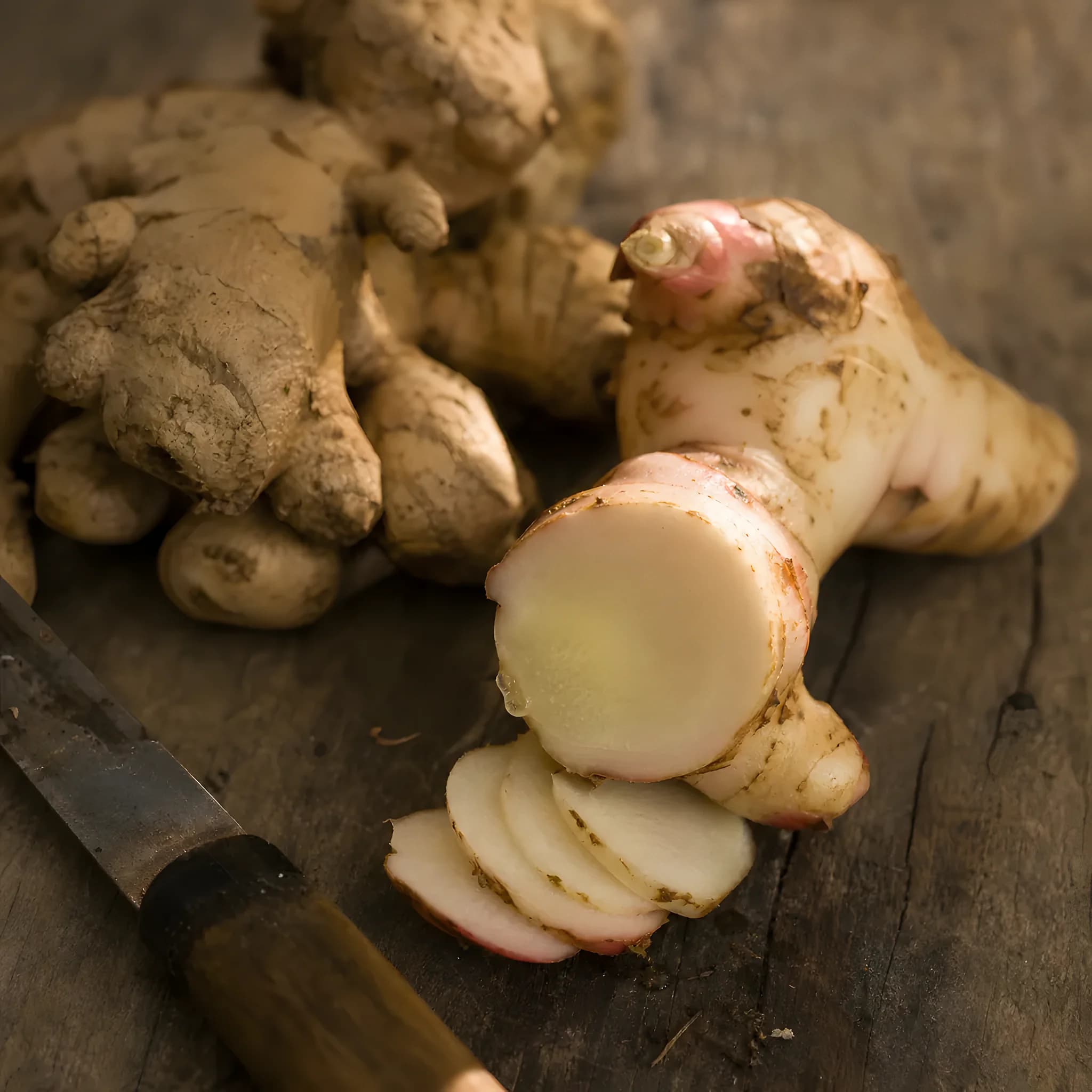
Official texts attach the name galangal, or galanga, to different plants, so ask the supplier to state the botanical name on the specification alongside the common name. GRIN, the US Department of Agriculture's plant database, records "greater galanga" as an English name for Alpinia galanga (L.) Willd. and "lesser galangal" for Alpinia officinarum Hance. The texts buyers meet do not all point at the same species. The US list of spices generally recognised as safe for their intended use, 21 CFR 182.10, names "Galanga (galangal)" against "Alpinia officinarum Hance." (eCFR version of 6 October 2026). Indonesia's herbal pharmacopoeia defines lengkuas as the rhizome of Alpinia galanga (our translation). This guide sets out how each text names galangal, how it differs from ginger on paper, how it appears on labels, and what to ask a supplier.
What Are Greater and Lesser Galangal?
Both are in the genus Alpinia, family Zingiberaceae, in GRIN's records. GRIN lists Alpinia galanga (L.) Willd. under the English names "greater galanga", "languas" and "Siamese-ginger", and gives Maranta galanga L. and Languas galanga (L.) Stuntz as synonyms. It lists Alpinia officinarum Hance under "lesser galangal", "lesser galanga" and "Chinese-ginger", with Languas officinarum (Hance) Farw. as a synonym. GRIN records the German name "Galgant" for both.
Their recorded ranges differ. GRIN lists Alpinia officinarum as native to Guangdong and Guangxi in China. For Alpinia galanga it lists native records including Guangdong, Guangxi and Yunnan in China, Myanmar, Thailand, Vietnam, the Philippines, Singapore and Kalimantan in Indonesia; it marks India, Indochina and Malaysia "native?" and notes "(exact native range obscure)".
The epithet galanga also belongs to a third plant in another genus. GRIN records the English name "galanga" for Kaempferia galanga L. Indonesia's Farmakope Herbal Indonesia, second edition (2017), defines kencur rhizome as the rhizome of Kaempferia galanga L. and lengkuas rhizome as the rhizome of Alpinia galanga (L.) Willd., in separate monographs (our translation). A document that says only "galanga" could mean either genus.
How Do Galangal and Ginger Differ on a Specification?
Alpinia galanga, Alpinia officinarum and Kaempferia galanga share ginger's family in GRIN's records, but none shares its genus. GRIN places Zingiber officinale Roscoe, ginger, in family Zingiberaceae, subfamily Zingiberoideae, and both Alpinia species in subfamily Alpinioideae.
Food texts keep them apart. 21 CFR 182.10 lists "Galanga (galangal)" and "Ginger" as separate rows, with ginger against "Zingiber officinale Rosc.". Malaysia's Food Regulations 1985 state that "Ginger shall be the rhizome of the plant Zingiber officinale" (regulation 315, text updated until August 2026), and regulation 316 defines ginger powder as the powder obtained by grinding the clean, dried rhizome of the same species. Singapore's list of Chinese medicinal materials commonly used in food has separate entries for ginger, Zingiber officinale (item 118), and lesser galangal, Alpinia officinarum (item 108).
GRIN's English names include "Siamese-ginger" for Alpinia galanga and "Chinese-ginger" for Alpinia officinarum. These names mean that the word ginger on a document could be ambiguous, so ask the supplier to confirm the botanical name.
How Do Food Rules Name Galangal?
United States. 21 CFR 182.10 opens: "Spices and other natural seasonings and flavorings that are generally recognized as safe for their intended use, within the meaning of section 409 of the Act, are as follows". Its galangal row reads "Galanga (galangal)", botanical name "Alpinia officinarum Hance." (eCFR, 6 October 2026). The definition of spice in 21 CFR 101.22(a)(2) covers "any aromatic vegetable substance in the whole, broken, or ground form" that is, among other conditions, "true to name", and says spices include those listed in § 182.10 and part 184. We did not search part 184 or the rest of Title 21, and make no statement about them.
Singapore. The Singapore Food Agency's list of Chinese medicinal materials commonly used in food (as at November 2025) was established by the Agri-Food and Veterinary Authority and the Health Sciences Authority "to serve as a guide to the industry on the list of traditional Chinese medicinal materials that are allowed in food". It "is applicable to the use of whole herbs or whole extracts in food". Item 108 is Alpinia officinarum, "Lesser galangal rhizome", 高良姜, with the rhizome as the part commonly used in food and 31 August 2004 in the list's "Date of Ascension" column.
Malaysia. Regulation 286(1) of the Food Regulations 1985 includes rhizomes in its definition of spice, subject to the conditions in that definition: the plant parts must be sound, suitable for use as condiments for imparting flavour or aroma to food, and must not have had their naturally present oil or other flavouring constituent removed. It also says "Spice may be dried or ground or both" (English text updated until August 2026, P.U. (A) 48/2026). In the English and Malay texts we read, we found no regulation headed galangal or lengkuas.
Indonesia. Farmakope Herbal Indonesia, second edition (2017), from the Ministry of Health, defines rimpang lengkuas as the rhizome of Alpinia galanga (L.) Willd., family Zingiberaceae, under the Latin title "Alpiniae Galangae Rhizoma" (our translation). Its foreword describes it as a standard in the field of pharmacy, mainly for traditional medicine raw materials (our translation). It is a naming reference here, not food law.
How Does Galangal Appear on Food Labels?
On US labels, 21 CFR 101.22(h)(1) states that spice may be declared as "spice" in the statement of ingredients (eCFR, 6 October 2026). In the EU, Annex VII Part B of Regulation (EU) No 1169/2011 (consolidated text of 1 April 2025) allows "All spices not exceeding 2 % by weight of the food" that are constituents of another food to be designated "Spice(s)" or "mixed spices", without prejudice to Article 21.
Because these provisions allow category names within their stated conditions, a finished-product label might not name galangal, let alone the species. For that reason, ask the supplier to state the species on the specification and on each lot's certificate of analysis.
What Should You Ask a Galangal Supplier?
- Botanical name with author. Ask for Alpinia galanga (L.) Willd. or Alpinia officinarum Hance on the specification and on each lot's certificate of analysis, not only "galangal" or "galanga". The US spice list names Alpinia officinarum, Indonesia's lengkuas rhizome monograph names Alpinia galanga (our translation), and GRIN records "galanga" for Kaempferia galanga as well.
- Synonyms. If a document uses Languas galanga or Languas officinarum, ask the supplier to confirm the corresponding Alpinia name. GRIN records each as a synonym of one Alpinia species.
- Part and form. Ask which plant part is supplied, whether it is whole, broken or ground, and whether it is dried. The US spice definition covers the "whole, broken, or ground form", and Malaysia's says spice "may be dried or ground or both".
- Identity on every lot. Ask how the supplier confirms species for each lot, who performs the check, and whether it covers ground product as well as whole or broken rhizome.
- Country of origin. Ask the supplier to state the country of origin.
- Market documents. Ask which regulatory texts or guidance the documents refer to: 21 CFR 182.10 and the "true to name" condition in 21 CFR 101.22(a)(2) for the US, regulation 286 for Malaysia, and item 108 of the SFA guide for lesser galangal used as a Chinese medicinal material in food in Singapore.
- Ginger in the same product. If a blend carries both, ask for each on its own line with its botanical name, since US and Malaysian texts treat ginger as Zingiber officinale.
Is Lesser Galangal the Same as Kencur?
No, in the texts we read. GRIN records "lesser galangal" as an English name for Alpinia officinarum Hance. Indonesia's Farmakope Herbal (2017) defines kencur as the rhizome of Kaempferia galanga L. (our translation), a different genus, which GRIN lists in subfamily Zingiberoideae.
Which Galangal Does 21 CFR 182.10 Name?
Alpinia officinarum. The section's row reads "Galanga (galangal)" with the botanical name "Alpinia officinarum Hance." (eCFR version of 6 October 2026). This guide does not cover other parts of US rules, such as part 184.
What Is Lengkuas?
In Indonesia's herbal pharmacopoeia (Farmakope Herbal Indonesia, second edition, 2017), rimpang lengkuas is the rhizome of Alpinia galanga (L.) Willd., family Zingiberaceae (our translation). GRIN records "greater galanga" as an English name for the same species.
Is Galangal a Kind of Ginger?
Galangal and ginger are in the same family, Zingiberaceae, but different genera, in GRIN's records. Malaysia's Food Regulations 1985 define ginger as "the rhizome of the plant Zingiber officinale", and the US spice list keeps galangal and ginger as separate entries.
Sources
- United States, 21 CFR 182.10, spices generally recognised as safe (eCFR, version of 6 October 2026)
- United States, 21 CFR 101.22, paragraphs (a)(2) and (h)(1), spices on food labels (eCFR, version of 6 October 2026)
- USDA Agricultural Research Service, GRIN Taxonomy, Alpinia galanga (L.) Willd. (accessed 11 October 2026)
- USDA Agricultural Research Service, GRIN Taxonomy, Alpinia officinarum Hance (accessed 11 October 2026)
- USDA Agricultural Research Service, GRIN Taxonomy, Kaempferia galanga L. (accessed 11 October 2026)
- USDA Agricultural Research Service, GRIN Taxonomy, Zingiber officinale Roscoe (accessed 11 October 2026)
- Singapore Food Agency, List of Chinese Medicinal Materials Commonly Used in Food (as at November 2025)
- Malaysia, Ministry of Health, Food Regulations 1985, regulations 286, 315 and 316 (English text updated until August 2026)
- Indonesia, Kementerian Kesehatan, Farmakope Herbal Indonesia Edisi II (2017), monographs Rimpang Lengkuas and Rimpang Kencur (in Indonesian)
- Regulation (EU) No 1169/2011 on the provision of food information to consumers, Annex VII Part B (consolidated text 01.04.2025)
- Malaysia, Kementerian Kesihatan, Peraturan-Peraturan Makanan 1985 (Malay text updated until August 2026)