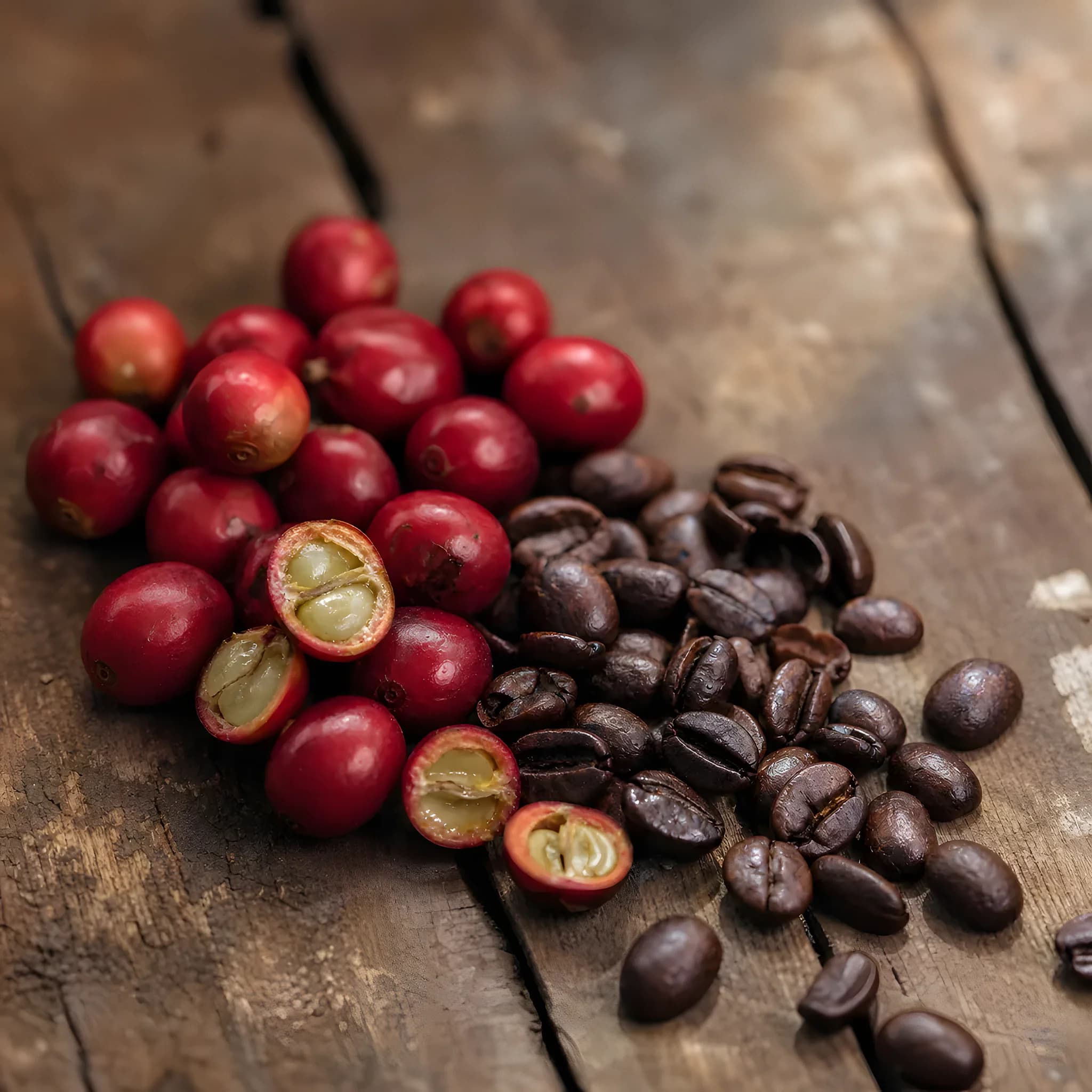
None of the food regulations read for this guide names arabica, robusta or liberica in its definition of coffee. Malaysia's Food Regulations 1985 and Singapore's Food Regulations define coffee by the genus Coffea, Thailand's coffee notification names the genus Coffea, and the Australia New Zealand Food Standards Code defines coffee as a product prepared by roasting, grinding, or both roasting and grinding, coffee beans. Indonesia's food category regulation uses "Coffea sp" in its coffee entries; its list of plant raw materials gives kopi hijau (green coffee) as Coffea canephora, with Coffea robusta L.Linden among the synonyms (our translation). Among the texts read, the species are named in two standards for green coffee beans: the Philippine standard PNS/BAFS 01:2025 and the ASEAN Standard for Coffee Bean. Coffee mixtures, premixes, coffee with chicory, chicory itself, ready-to-drink coffee, coffee drinks and powders, creamers, and caffeine rules for other beverages have their own entries, which this guide names but does not cover. No Codex text was read for this guide.
Which Coffee Species Do the Official Texts Name?
PNS/BAFS 01:2025, Green Coffee Beans, "applies to dried green coffee beans of commercial varieties grown from Coffea arabica L., Coffea robusta L. (Coffea canephora Pierre ex Froehner), Coffea liberica Bull ex Hiern and Coffea liberica var. dewevrei of the Rubiaceae family to be supplied to the consumer after preparation, postharvest treatment, and packaging. Industrially-processed coffee beans are excluded." Its table of defects gives totals per variety for "arabica", "robusta", "liberica" and "excelsa"; the figures are grading tolerances and are not described here.
The ASEAN Standard for Coffee Bean (ASEAN Stan 31: 2013) applies to "dried green coffee bean of commercial varieties grown from Coffea arabica L., Coffea robusta L.(Coffea canephora Pierre ex Froehner), Coffea liberica Bull ex Hiem and Coffea excelsa Chev of the Rubiaceae family supplied to processors for human consumption." The two lists differ: the Philippine standard names Coffea liberica var. dewevrei where ASEAN names Coffea excelsa Chev, the authority after Coffea liberica is printed "Hiern" in one and "Hiem" in the other, and the Philippine standard serves beans supplied to the consumer while ASEAN's serve processors. Neither standard says whether it is mandatory.
Indonesia's BPOM Regulation 13 of 2023 lists, among raw materials of plant origin without restriction of use, Kopi (Coffea sp.) and Kopi hijau (Coffea canephora), with the seed as the part that may be used. The synonyms printed for Coffea canephora include Coffea canephora var. robusta (L. Linden) A. Chev., Coffea robusta L.Linden and Coffea arabica var. stuhlmannii A.Froehner (our translation).
What Is Green Coffee in These Texts?
Malaysia's regulation 265 reads: "Coffee bean shall be the seed of any species of Coffea, either raw or roasted." Singapore's regulation 157 reads: "“Coffee” shall be the seed or ground seed of one or more of the various species of Coffea."
In the Philippine standard, green coffee bean is the "commercial term designating the dried seed of the coffee plant, detached from their external envelopes", with coffee bean as an admitted term; coffee is a general term for the fruits and seeds of plants of the family Rubiaceae, genus Coffea, generally cultivated species, and for products from those fruits and seeds at different stages of processing and use, intended for consumption. Green coffee beans are graded Extra Class, Class I or Class II, and "No food additives shall be used in green coffee beans." Retail and non-retail labelling follows the mandatory label information clause of PNS/BAFS 384:2024 or its latest issuances. ASEAN classes are "Extra" Class, Class I and Class II. ASEAN non-retail containers carry the name and address of the exporter, packer and/or dispatcher, the "Name of produce, variety and/or commercial type.", the country of origin, the class and the size, marked legibly and indelibly, grouped on the same side and visible from the outside, or in documents accompanying the shipment; for produce transported in bulk, these particulars must appear on a document accompanying the goods. Minimum requirements, sizing, tolerances, presentation, contaminant and hygiene clauses of both standards are not covered here, nor are the Philippine codes of practice for coffee good agricultural practices and ochratoxin A, the coffee machinery standards on the same list, or the Codex code of practice on ochratoxin A in coffee that ASEAN names. ASEAN Annex 2 also lists common names of coffee bean in member states; those names are not covered here. ASEAN's reference list also names national green coffee bean standards of Indonesia, Malaysia, the Philippines, Thailand (Robusta and Arabica) and Vietnam, which were not read.
In Indonesia, BPOM's entry biji kopi (coffee beans) covers seeds of the Coffea sp plant that are whole and already roasted, with water content not more than 12 per cent (our translation). Thailand's notification makes roasted coffee the food for which quality or standards are prescribed (our translation).
How Do the Regulations Define Roasted and Ground Coffee?
Malaysia. Regulation 266(1) reads: "Coffee or ground coffee or coffee powder shall be the pure roasted coffee bean that is ground or otherwise prepared so as to be suitable for making an infusion or decoction. It shall be free from husk and any other substance." Under regulation 266(2) it must contain not more than 7 per cent of water, not more than 5 per cent and not less than 3 per cent of ash, not more than 2.5 per cent and not less than 0.9 per cent of anhydrous caffeine, not more than 33 per cent and not less than 22 per cent of water soluble extract, and not less than 8.5 per cent of fat. Regulation 266(3) reads: "Where coffee is derived exclusively from one location, the name of that location may appear in the label on that package of coffee."
Australia and New Zealand. Standard 1.1.2 (compilation 21, in force from 9 June 2026) reads: "coffee means the product prepared by roasting, grinding, or both roasting and grinding, coffee beans." Standard 2.10.4 (compilation 2, in force from 9 June 2026) requires food sold on the basis that it is "coffee" to be coffee.
Indonesia. BPOM defines kopi bubuk (ground coffee) as roasted and then ground coffee beans, with anhydrous caffeine content not more than 2.5%, and water content not more than 7 per cent (our translation).
Thailand. Notification No. 197 of 2000 (Thai FDA consolidated text) defines กาแฟแท้ (genuine coffee) as a product obtained from fully ripe fruit of coffee plants of the genus Coffea, whose seeds are removed and roasted and may be ground to the required size. Genuine coffee must have total ash not more than 6 per cent by weight, of which not less than 75 per cent by weight dissolves in water; caffeine not less than 1 per cent by weight; and sugar, calculated as total invert sugar, not more than 1.5 per cent by weight. No other substance may be mixed in except substances not harmful to health used for roasting and flavouring, and food additives follow the Ministry's food additive notification (our translation). Its odour and taste condition is not described here.
What Do the Texts Call Instant or Soluble Coffee?
Malaysia's regulation 267 defines instant coffee or soluble coffee as the dried soluble solids obtained from water extraction of freshly roasted, pure coffee beans, "in the form of free flowing powder or granule having the colour, taste and flavour characteristic of coffee." It "shall contain not less than 2.25 per cent of anhydrous caffeine derived from coffee", "shall not contain added substance" and "shall dissolve in boiling water in 30 seconds with moderate stirring." The label carries the words "soluble coffee" or "instant coffee", and "pure" or "pure coffee", or any word or words having the same or a similar effect, may appear only in uniform lettering not larger than the name of the food and immediately followed by the word "extract".
Singapore's regulation 160 reads: "Instant coffee or soluble coffee shall be the dried soluble solid obtained from a water extraction of coffee and shall be in the form of a free-flowing powder having the colour, taste and flavour characteristic of coffee." It must be free from impurities, must not contain chicory or any other added substances, and "shall contain not more than 5% (w/w) moisture and not more than 12% (w/w) total ash, and not less than 2.25% (w/w) anhydrous caffeine on the moisture-free basis. It shall dissolve in boiling water in 30 seconds with moderate stirring."
The Food Standards Code reads: "instant coffee means the dried soluble solids prepared from the water extraction of coffee." Food sold as "instant coffee" or "soluble coffee" must be instant coffee. BPOM defines kopi instan as a dry product readily soluble in water, with caffeine content not less than 2% and not more than 8%, obtained entirely by water extraction of roasted coffee beans (Coffea sp) (our translation).
Thailand defines กาแฟสำเร็จรูป (instant coffee) as a product from fully ripe Coffea fruit whose seeds are removed and roasted without mixing anything else, extracted with water only and dried by a suitable process, in powder, flakes or another form, able to dissolve completely in water at once. It must have moisture not more than 5 per cent by weight, total ash not less than 5 per cent of dry weight (as printed in the Thai text) and caffeine not less than 2.5 per cent by weight (our translation). Its odour and taste condition is not described here.
How Is Decaffeinated Coffee Defined?
Each text sets its limit on its own basis, and the figures below are not converted.
- Malaysia. Regulation 267A(1) reads: "Decaffeinated coffee shall be the dried soluble solids obtained from water-extraction of freshly roasted coffee beans where caffeine has been removed." It must contain not more than 3 g/kg (w/w) of anhydrous caffeine and no added substance. In this text, decaffeinated coffee is defined as soluble solids.
- Singapore. Regulation 162: "Decaffeinated coffee shall be coffee which contains not more than 0.1% (w/w) anhydrous caffeine. It shall contain no ingredient other than those normally present in coffee." Decaffeinated instant coffee or decaffeinated soluble coffee "contains not more than 0.3% (w/w) anhydrous caffeine based on the moisture-free basis."
- Australia and New Zealand. Standard 1.1.2 reads: "decaffeinated coffee means coffee from which most of the caffeine has been removed." Under Standard 2.10.4, food sold as decaffeinated coffee must contain no more than 1 g/kg of anhydrous caffeine on a dry basis, and food sold as decaffeinated instant coffee or decaffeinated soluble coffee must be instant coffee with no more than 3 g/kg of anhydrous caffeine on a dry basis.
- Indonesia. BPOM defines kopi dekafein as coffee from which most of the caffeine has been removed, with not more than 1 g/kg anhydrous caffeine calculated on dry weight, and kopi instan dekafein as instant coffee from which most of the caffeine has been removed, with not more than 3 g/kg calculated on dry weight (our translation).
- Thailand. กาแฟที่สกัดกาเฟอีนออก (decaffeinated coffee) is a product from genuine coffee from which caffeine has been extracted, with caffeine not more than 0.1 per cent by weight; กาแฟสำเร็จรูปที่สกัดกาเฟอีนออก (decaffeinated instant coffee) has moisture not more than 5 per cent by weight and caffeine not more than 0.3 per cent by weight. Both must meet quality or standards approved by the Food and Drug Administration (our translation).
What Counts as Coffee Extract or Essence?
Malaysia's regulation 268 reads: "Coffee essence or liquid coffee extract shall be the essence or liquid extract from coffee, with or without the addition of glycerol or sugar or a combination of these. It shall not contain any other added substance. It shall contain not less than 0.5 per cent of anhydrous caffeine derived from coffee." The label must show "coffee essence" or "liquid coffee extract" in larger letters than any other words, and a statement of the percentage of caffeine in the coffee; the word "pure" or words to the same or similar effect may not be used.
BPOM's konsentrat minuman kopi (coffee drink concentrate) and sirup kopi (coffee syrup) are separate entries, which this guide does not describe (our translation). BPOM category 14.1.5 also includes coffee beans treated for the coffee-product industry; that inclusion is not described here (our translation).
Which Coffee Products Have Separate Entries?
Malaysia: coffee mixture (269), premix coffee (269A, which in ready-to-drink form is construed to be a coffee drink), chicory (270), coffee and chicory (271), instant coffee and chicory (272) and coffee and chicory essence (273). Malaysia's soft drink standard in regulation 348 excludes tea, coffee, chicory, cocoa and their related products as specified in the Regulations. Regulations 351 and 354 on caffeine-containing plant extracts in flavoured syrups or cordials and flavoured drinks, and regulation 360(5) on the caffeine statement required on flavoured syrups and drinks to which caffeine has been added, are not described here. Singapore: coffee and chicory (158), coffee mixture (159) and instant coffee and chicory (161). BPOM: kopi campur (mixed coffee), kopi celup (coffee bags), three powdered coffee drinks, formulated caffeinated beverages, minuman kopi (coffee drink), kapucino, chicory root, creamers for drinks such as coffee, and a flavoured milk and cream powder that may be flavoured with ground coffee (our translation). Thailand: mixed coffee, mixed instant coffee, ready-to-drink coffee in liquid or dry form, and the caffeine statement required on ready-to-drink liquid coffee labels (our translation). The Food Standards Code: high caffeine coffee beverages and their labelling requirements, and formulated caffeinated beverages. Singapore's soft drinks regulation 183 was not read for this guide.
How Is Coffee Classified for Trade?
In the WCO HS nomenclature, 2022 edition, heading 09.01 reads "Coffee, whether or not roasted or decaffeinated; coffee husks and skins; coffee substitutes containing coffee in any proportion." Coffee, not roasted, splits into 0901.11 "-- Not decaffeinated" and 0901.12 "-- Decaffeinated"; coffee roasted into 0901.21 "-- Not decaffeinated" and 0901.22 "-- Decaffeinated"; and 0901.90 is "- Other". The six-digit HS subheadings do not split coffee by species.
Heading 21.01 covers "Extracts, essences and concentrates, of coffee, tea or maté and preparations with a basis of these products or with a basis of coffee, tea or maté; roasted chicory and other roasted coffee substitutes, and extracts, essences and concentrates thereof." Its coffee subheadings are 2101.11 "-- Extracts, essences and concentrates" and 2101.12 "-- Preparations with a basis of extracts, essences or concentrates or with a basis of coffee"; 2101.30 covers roasted chicory and other roasted coffee substitutes and their extracts. Chapter 21 Note 1(b) sends roasted coffee substitutes containing coffee in any proportion to heading 09.01, and Note 2 classifies extracts of those substitutes in heading 21.01. Neither Chapter 9 nor Chapter 21 of the 2022 HS nomenclature uses the words instant or soluble. National tariff schedules and the HS Explanatory Notes were not checked.
What Should You Ask a Coffee Supplier?
- Species. Ask for the species or commercial type as printed in the standard the beans are graded against, for example Coffea liberica Bull ex Hiern in PNS/BAFS 01:2025 or Coffea excelsa Chev in the ASEAN standard.
- Market definition. Ask which market's definition the product meets, and whether "decaffeinated" means a roasted coffee or, as in Malaysia's regulation 267A, dried soluble solids.
- Caffeine basis. For decaffeinated coffee, ask for the caffeine result on the basis the target market prints: w/w, moisture-free, dry basis or by weight.
- Name on the label. Ask whether a product sold as instant coffee contains anything added, since Malaysia and Singapore both define coffee mixtures and coffee and chicory separately, and Malaysia also defines premix coffee.
- HS line. Ask for the subheading, roasted or not and decaffeinated or not, and confirm the national tariff line with the importing country.
Is Robusta or Arabica Part of the Legal Definition of Coffee?
Not in the regulations read. Malaysia defines coffee bean, and Singapore coffee, by the genus Coffea, Thailand names the genus, and the Food Standards Code's definition of coffee names no botanical genus or species. BPOM lists Coffea canephora, with Coffea robusta L.Linden among its synonyms, only in its raw-material list (our translation). The species names appear in PNS/BAFS 01:2025 and the ASEAN standard, and the ASEAN standard, which does not say whether it is mandatory, requires the variety and/or commercial type on non-retail packages or in accompanying documents; for produce transported in bulk, accompanying documentation is required.
Is Liberica Covered by the Green Coffee Standards?
Yes. PNS/BAFS 01:2025 names Coffea liberica Bull ex Hiern and Coffea liberica var. dewevrei, and the ASEAN standard names Coffea liberica Bull ex Hiem and Coffea excelsa Chev. The Philippine table of defects lists liberica and excelsa separately.
How Much Caffeine May Decaffeinated Coffee Contain?
It depends on the text. Malaysia limits anhydrous caffeine in decaffeinated coffee to not more than 3 g/kg (w/w) and defines decaffeinated coffee as soluble solids. Singapore limits anhydrous caffeine to 0.1% (w/w) in decaffeinated coffee and 0.3% (w/w), on the moisture-free basis, in decaffeinated instant or soluble coffee. The Food Standards Code limits anhydrous caffeine to 1 g/kg in decaffeinated coffee and 3 g/kg in decaffeinated instant or soluble coffee, both on a dry basis, and BPOM sets the same anhydrous caffeine limits calculated on dry weight (our translation). Thailand limits caffeine to 0.1 per cent by weight in decaffeinated coffee and 0.3 per cent by weight in decaffeinated instant coffee (our translation).
Which HS Code Covers Green Coffee?
In the 2022 WCO HS nomenclature, coffee not roasted falls under 0901.11 when not decaffeinated and 0901.12 when decaffeinated. Roasted coffee falls under 0901.21 and 0901.22. National tariff schedules were not checked.
Sources
- Malaysia, Ministry of Health, Food Regulations 1985, regulations 265 to 273, 348, 351, 354 and 360 (English text updated until August 2026)
- Singapore Food Regulations, regulations 157 to 162 (current version as at 12 October 2026)
- Food Standards Australia New Zealand, Australia New Zealand Food Standards Code, Standard 1.1.2 Definitions used throughout the Code
- Food Standards Australia New Zealand, Australia New Zealand Food Standards Code, Standard 2.10.4 Miscellaneous standards for other foods
- Indonesia, BPOM Regulation No. 13 of 2023 on Food Categories, Lampiran I and Lampiran II (source in Indonesian, our translation)
- Thailand, Food and Drug Administration, Notification of the Ministry of Public Health No. 197 B.E. 2543 Re: Coffee, with amendments (source in Thai, our translation)
- Philippines, Bureau of Agriculture and Fisheries Standards, PNS/BAFS 01:2025 Green Coffee Beans, Product Standard, Grading and Classification (list of approved Philippine National Standards)
- ASEAN Standard for Coffee Bean (ASEAN Stan 31: 2013)
- World Customs Organisation, HS nomenclature 2022 edition, Chapter 9
- World Customs Organisation, HS nomenclature 2022 edition, Chapter 21