Check which legal name a cocoa contract uses, because the official texts read give each stage of the bean its own name and conditions. Malaysia's Food Regulations 1985, Singapore's Food Regulations and the Australia New Zealand Food Standards Code each use "cocoa" on its own as a name for the powder. Thailand's Notification No. 442 is the only text read that defines cacao powder as a product separate from cocoa powder. Chocolate has its own entries in the Malaysian, Singapore, Australian and New Zealand, Thai and Indonesian texts read: Malaysia's regulations 279 to 281 and 135(3) on biscuit coatings described as chocolate, Singapore's regulations 168 to 170, Standard 2.10.4 of the Food Standards Code, Thailand's Notification No. 441 and Indonesia's food categories 05.1.4 and 05.1.5. This guide does not cover them.
Is Cacao a Separate Product From Cocoa?
Malaysia, Singapore and the Philippine standards use cacao in the plant name or in names for beans, nibs or mass. Malaysia uses "cacao" only in the species name, Theobroma cacao. Singapore's regulations 163 and 164 print "cacao beans" and "cacao nibs" in brackets as alternative names for cocoa beans and cocoa nibs. The Philippine standards use "cacao or cocoa beans" and "cacao mass". The Food Standards Code standards read, Indonesia's food category regulation and HS Chapter 18 do not use the word.
Thailand is the exception. Notification of the Ministry of Public Health No. 442 (B.E. 2566), on cocoa bean products, defines "โกโก้ผง (Cocoa powder)" and "คาเคาผง (Cacao powder)" as two products, and the Thai Food and Drug Administration's clarification says the difference between them is the raw material and the production process (our translation).
Which Texts Define the Cocoa Bean?
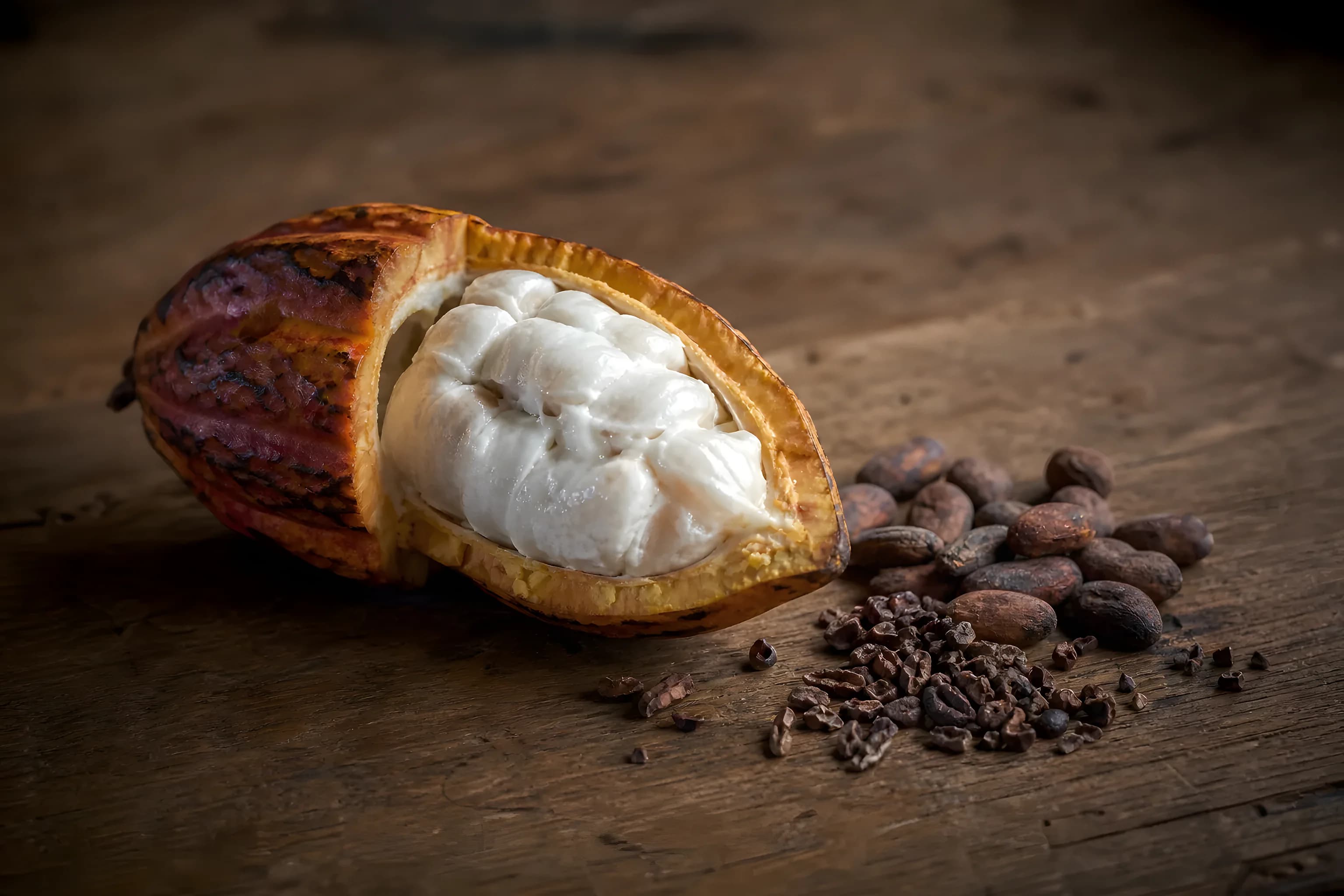
Malaysia. Regulation 274 of the Food Regulations 1985 (English text updated until August 2026) reads: "Cocoa bean shall be the properly fermented, dried whole seed of the cocoa tree Theobroma cacao."
Singapore. Regulation 163 of the Food Regulations (current version as at 12 October 2026) reads: "Cocoa beans (cacao beans) shall be the seeds of Theobroma cacao L. or other closely related species."
Philippines. PNS/BAFS 58:2019, the Philippine standard for cacao or cocoa beans, defines both terms as "seed of the cacao or cocoa tree (Theobroma cacao Linnaeus)". For beans in trade outside the producing country, moisture determined at the first port of destination or later delivery points "shall not exceed 7.5 % and not below 5.5%", and a consignment "shall contain no more than 2% waste (detritus) by weight". The marking lists "Name of product (fermented or unfermented)", grade and bean size, net weight in kilograms, "Origin of produce (country)", lot identification code or number, and an optional official inspection mark. Other defined bean terms and quality requirements, its grade tables, and the cacao codes of practice and machinery standards on the same Philippine list are not covered here.
Neither Thailand's Notification No. 442 nor Indonesia's food category regulation (BPOM Regulation 13 of 2023) contains a separate definition of cocoa beans themselves.
Which Texts Define Cocoa Nibs?
Malaysia. Regulation 275 reads: "Cocoa nib or cracked cocoa shall be the roasted cocoa bean freed from its shell or husk, with or without the germ."
Singapore. Regulation 164 reads: "Cocoa nibs (cacao nibs, cracked cocoa) shall be prepared by heating and cracking cleaned, dried or cured cacao beans and removing the shell therefrom."
Indonesia's BPOM describes cocoa nib as cleaned cocoa beans free of the shell (our translation). Thailand names cocoa nibs only inside its cocoa mass definition. No heading in HS Chapter 18 names nibs.
What Do Cocoa Mass, Paste and Liquor Mean?
Malaysia. Regulation 276 gives four names, "Cocoa paste, cocoa mass, cocoa slab or cocoa liquor", for the solid or semi-solid mass produced by grinding cocoa nibs. "It shall contain not less than 48 per cent of cocoa fat." On a water-free basis it shall not contain more than 19 per cent of starch naturally present, 7 per cent of crude fibre, 8 per cent of total ash, 5.5 per cent of ash insoluble in water and 0.4 per cent of ferric oxide.
Singapore. Regulation 165 names "Cocoa paste, cocoa mass or cocoa slab" and reads: "It shall not contain any foreign fat or oil."
Thailand. Notification No. 442 defines "เนื้อโกโก้บด (Cocoa mass)" or "โกโก้ข้นเหลว (Cocoa liquor)" as the product of crushing or grinding cocoa nibs, roasted or not roasted. Cocoa shell and germ must be not more than 5 per cent calculated on the fat-free dry matter, or not more than 1.75 per cent calculated alkali-free for cocoa shell only, and cocoa butter between 47 and 60 per cent (our translation).
Indonesia. BPOM defines kakao massa (cocoa liquor) as a paste obtained from cocoa nib by grinding without removing its fat content (our translation), and lists keik kakao (cocoa cake) separately.
Philippines. PNS/BAFS 111:2021 covers cacao mass (Philippine Tablea), "made from pure (100%) cacao or cocoa bean (Theobroma cacao L.), either fermented or unfermented, dried, roasted, dehulled, ground, and molded without added ingredients and additives." Its Table 1 sets particle size "<100" microns, pH "5-6", moisture of 3 per cent maximum relative to the product's dry weight, water activity of 0.6 maximum and crude fat content above 45 g/100g. The product "shall have no additives", and its label name is "Cacao mass “Philippine Tablea”". Its remaining label particulars and its colour, odour and taste characteristics are not covered here.
What Is Cocoa Butter in Each Text?
Malaysia. Regulation 277 reads: "Cocoa butter shall be the fat produced from cocoa beans, cocoa nibs or cocoa paste by a mechanical or chemical process. It shall be free from other fats and oils including ermitt oil, and other substance." ("ermitt" as printed). It sets a saponification value of from 185 to 200 milligrams of potassium hydroxide per gram, an iodine value of from 32 to 42, a melting point of not less than 29°C, a refractive index at 40°C of from 1.456 to 1.459, and not more than 1.75 per cent w/w of free fatty acid, as oleic acid. Cocoa butter "may contain permitted antioxidant".
Thailand. Notification No. 442 defines cocoa butter as the fat obtained from cocoa beans, with free fatty acid, calculated as oleic acid, of not more than 1.75 per cent and unsaponifiable matter of not more than 0.7 per cent, except not more than 0.35 per cent for press cocoa butter. Press cocoa butter is also a permitted label name if the product meets the standard (our translation).
Indonesia. BPOM defines lemak kakao (cocoa butter) as the fat obtained from cocoa beans, with free fatty acid (as oleic acid) of not more than 1.75%, unsaponifiable matter of not more than 0.7%, except not more than 0.35% for pressed cocoa butter, and moisture of not more than 0.2% (our translation).
Singapore's regulations 163 to 170 contain no separate cocoa butter entry, and the Food Standards Code standards read define none.
What Is Cocoa Powder in Each Text?
Malaysia. Regulation 278 reads: "Cocoa or cocoa powder or soluble cocoa shall be the powdered product prepared from cocoa paste. It shall be deprived of a portion of its fat and may be treated with alkali or alkaline salts." In its water-free, fat-free and alkali-free content it shall meet the cocoa paste limits of regulation 276(2), and in its water-free and fat-free content it shall not contain more than 10.5 per cent of total alkalinity calculated as potassium carbonate or 12.5 per cent of ash. It "may contain permitted flavouring substance and permitted food conditioner".
Singapore. Regulation 166 reads: "Cocoa, cocoa powder or powdered cocoa shall be the powdered cocoa paste, deprived or not of a portion of its fat. It shall not contain any foreign fat or oil." Regulation 167 gives the name soluble cocoa to a different product: cocoa essence or soluble cocoa "shall be the product obtained by treating cocoa paste deprived or not of a portion of its fat with alkali or alkaline salt", and "shall not contain more than 3% (w/w) added alkali or alkaline salt, estimated as potassium carbonate, and shall not contain any foreign fat or oil".
Australia and New Zealand. Standard 2.10.4 of the Food Standards Code (compilation 2, in force 9 June 2026) says: "Food that is sold as ‘cocoa’ must be cocoa." Standard 1.1.2 (compilation 21, in force 9 June 2026) defines cocoa as "the powdered product prepared from cocoa beans from which a portion of the fat may have been removed, with or without salt or spices added."
Thailand. Notification No. 442 defines cocoa powder and cacao powder separately; their definitions set out production steps that this guide does not describe. Each powder has three grades based on cocoa butter content by dry weight: not less than 20 per cent; fat-reduced, from 10 per cent to less than 20 per cent; highly fat-reduced, less than 10 per cent. Moisture is not more than 7 per cent by weight for all six. The label name must match the type and grade, and a mixture of the two powders takes the cocoa powder name and may state the type and percentage of cacao powder near it (our translation). Clauses 4 to 8 add contaminant, microbiological, additive, flavouring, production and packaging requirements, not covered here.
Indonesia. BPOM defines kakao bubuk (cocoa powder) as a product made from cocoa mass with part of its fat removed. Its basic characteristics are moisture of not more than 5%, fat of not less than 10%, fineness of not less than 99.5% (b/b) passing a 200 mesh sieve and shell content of not more than 1.75% (b/b) calculated on alkali-free nib (our translation). Category 05.1.1 also lists cocoa dust, drinking cocoa mixes, drinking chocolate, instant cocoa and instant chocolate; categories 05.1.2 and 05.1.3 cover cocoa syrups and cocoa-based spreads and fillings, and category 05.4 includes chocolate coatings, sauces, toppings and spreads (our translation). These entries are not covered here.
What Changes When Cocoa Powder Contains Sugar?
The HS nomenclature, 2022 edition, gives subheading 1805.00 as "Cocoa powder, not containing added sugar or other sweetening matter." and subheading 1806.10 as "- Cocoa powder, containing added sugar or other sweetening matter", under heading 18.06, "Chocolate and other food preparations containing cocoa." The Thai FDA clarification says that cocoa powder or cacao powder with other ingredients added besides food additives and flavourings, such as sugar, sugar substitutes, salt, milk powder, nutrients or dietary fibre, is considered a beverage under the notification on beverages in sealed containers (our translation). BPOM separately defines cokelat bubuk (chocolate powder) as a mixture of cocoa powder and sugar, containing not less than 32% cocoa powder (29% calculated on a dry basis) (our translation).
How Is Cocoa Classified for Trade?
Chapter 18 of the WCO HS nomenclature, 2022 edition, is "Cocoa and cocoa preparations". Besides the powder subheadings above, it lists:
- 1801.00: "Cocoa beans, whole or broken, raw or roasted."
- 1802.00: "Cocoa shells, husks, skins and other cocoa waste."
- 18.03: "Cocoa paste, whether or not defatted.", split into 1803.10 not defatted and 1803.20 wholly or partly defatted.
- 1804.00: "Cocoa butter, fat and oil."
Note 1 to the chapter excludes preparations of certain other headings, among them 19.01 and 21.05, so a product containing cocoa can sit outside Chapter 18. Chapter Note 2 and subheadings 1806.20 to 1806.90 are not discussed here. National tariff schedules and the HS Explanatory Notes were not checked; confirm the national tariff line with the importing country.
What Should You Ask a Cocoa Supplier?
- Legal name. Ask which market's legal name the product is sold under; for Thailand, whether the powder is cocoa powder or cacao powder, and which fat grade.
- Soluble cocoa. If a document says soluble cocoa, ask whether it means Malaysia's regulation 278 product or Singapore's regulation 167 product, which have different definitions.
- Added sugar. Ask whether sugar or other sweetening matter has been added, because that moves cocoa powder from HS 1805.00 to 1806.10.
- Bean marking. For Philippine beans, ask for the fermented or unfermented name, grade and bean size, and country of origin on the marking.
Is Cacao Powder a Legal Name?
In Thailand, yes. Notification No. 442 defines cacao powder and its two fat-reduced grades and sets their label names. In Malaysia, Singapore and the Australia New Zealand Food Standards Code, the powder's legal names use cocoa, not cacao.
Which HS Code Covers Cocoa Powder?
In the 2022 edition of the WCO HS nomenclature, cocoa powder without added sugar or other sweetening matter is subheading 1805.00. Cocoa powder containing added sugar or other sweetening matter is subheading 1806.10. National tariff schedules were not checked.
Does a Cocoa Definition Cover Chocolate?
Chocolate has separate definitions, but Malaysia's regulations 279(2)(c) and 280(2)(b) also require chocolate and white chocolate to comply with the cocoa-paste requirements in 276(2), on a water-free, fat-free and alkali-free basis. The Malaysian, Singapore, Australian and New Zealand, Thai and Indonesian texts read give chocolate its own entries, separate from cocoa powder, cocoa mass and cocoa butter, and the HS puts chocolate in heading 18.06. In Standard 2.10.4 of the Food Standards Code, for example, cocoa and chocolate have separate definitions and separate rules for food sold under each name.
Is Soluble Cocoa the Same in Malaysia and Singapore?
No. In Malaysia, soluble cocoa is one of three names for the cocoa powder of regulation 278. In Singapore, regulation 167 defines soluble cocoa or cocoa essence as a product obtained by treating cocoa paste, deprived or not of a portion of its fat, with alkali or alkaline salt; added alkali or alkaline salt must not exceed 3% (w/w), estimated as potassium carbonate, and foreign fat or oil is prohibited.
Sources
- Malaysia, Ministry of Health, Food Regulations 1985, regulations 135 and 274 to 281 (English text updated until August 2026)
- Singapore Food Regulations, regulations 163 to 170 (current version as at 12 October 2026)
- Food Standards Australia New Zealand, Australia New Zealand Food Standards Code, Standard 2.10.4 Miscellaneous standards for other foods
- Food Standards Australia New Zealand, Australia New Zealand Food Standards Code, Standard 1.1.2 Definitions used throughout the Code
- Thailand, Food and Drug Administration, cocoa bean products law page: Notification of the Ministry of Public Health No. 442 (B.E. 2566) and the FDA clarification of it (source in Thai, our translation)
- Thailand, Notification of the Ministry of Public Health No. 441 (B.E. 2566) on chocolate and chocolate products (source in Thai)
- Indonesia, BPOM Regulation No. 13 of 2023 on Food Categories, Lampiran I, category 05.1 (source in Indonesian, our translation)
- Philippines, Bureau of Agriculture and Fisheries Standards, PNS/BAFS 58:2019 cacao or cocoa beans and PNS/BAFS 111:2021 cacao mass (Philippine Tablea) (list of approved Philippine National Standards)
- World Customs Organisation, HS nomenclature 2022 edition, Chapter 18