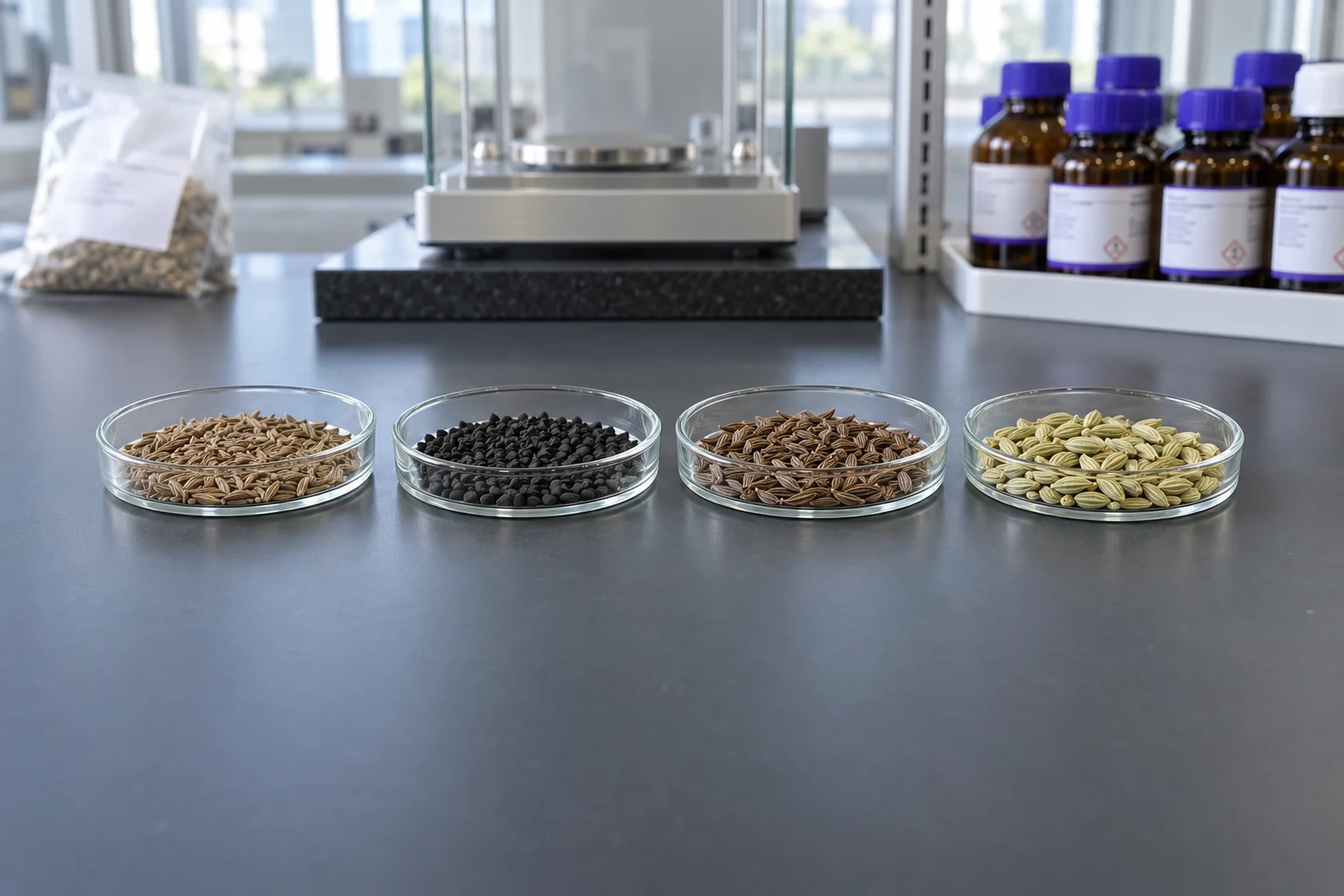
When you assess a flavour supplier, ask about four things: the specification, the certificate of analysis (CoA) for each batch, the safety data sheet (SDS) and allergen information. Each answers a different question. The specification sets out what you have agreed the flavour should be. The CoA reports test results for one batch. The SDS gives hazard information for the people who handle it. Allergen information helps you assess the declaration requirements for your own finished food. The rules discussed below, from Indonesia, Vietnam, Singapore and Australia and New Zealand, apply in different circumstances, and each section states when.
The certificate of analysis: one batch, tested
A CoA is a batch record. It reports results for a named batch, so it tells you about that batch and not the next one. Indonesia sets a useful minimum. For an import certificate (SKI) application for a food material, PerBPOM 26/2022 Pasal 14(6) requires the CoA to carry at least eight items (our translation): the producer's name and address, the material name, test parameters in accordance with applicable requirements, the test results, the method of analysis, the batch number, lot number or production code, the production date and the expiry date.
The same Pasal says who may issue it. Pasal 14(2) provides that the CoA "diterbitkan oleh produsen" (is issued by the producer), and Pasal 14(3) provides that where the producer does not issue it, it "hanya dapat diterbitkan oleh laboratorium terakreditasi" (may only be issued by an accredited laboratory). Under Pasal 14(7), BPOM may take samples and test them at an accredited laboratory to confirm that the CoA is correct and valid. Outside Indonesia, the eight items are still a sensible checklist for any CoA you accept. When a delivery arrives, check that the batch, lot or production code on the CoA matches the code on the container.
The specification: what you agreed
Ask for a specification that sets out the agreed parameters, their limits and the test methods, and compare each batch CoA with it. Agree it before the first commercial order, so that both sides measure batches against the same document. Indonesia lists it in the same import file. For an SKI application for an imported food material, Pasal 14(1) lists a CoA, or SPPT SNI for food materials subject to a mandatory Indonesian National Standard, alongside a "lembar data keamanan dan/atau spesifikasi bahan" (safety data sheet and/or material specification), a statement of intended use or distribution bearing the required stamp duty, and an invoice. Where a flavour contains a food additive, ask which purity specification the supplier works to. Our AO 2026-0011 guide explains how the Philippines refers food additives to JECFA specifications.
The safety data sheet: hazard information for your workplace
Singapore's regulation 43 of the Workplace Safety and Health (General Provisions) Regulations addresses safety data sheets for hazardous substances in workplaces. Regulation 43(2) provides: "Subject to regulation 44, where any hazardous substance is sold to any person for use in a workplace, it is a duty of the seller, or any agent of the seller who caused or procured the sale, to provide the buyer of the hazardous substance with a safety data sheet that gives accurate and adequate information on the hazardous substance." Regulation 44 excludes a hazardous substance "that is in a consumer package and that is intended for retail sale". So the duty depends on whether the flavour is a hazardous substance; ask the supplier for its classification.
The format matters too. The Ministry of Manpower states that an overseas SDS "has to be prepared in accordance with Singapore’s requirements for local use." Its circular MOM/OSHD/2023-04 gives 6 February 2025 as the effective date of the revised SS 586 Part 3, Preparation of Safety Data Sheets. If your supplier sends an SDS written for another market, ask for the Singapore version.
Allergen information: what may reach your label
Ask for allergen information so you can assess what your own label must declare. In Australia and New Zealand, section 4 of Standard 1.2.3 requires a declaration for foods listed in Column 1 of the table to section 3 of Schedule 9, and their derivatives, when present in a manner listed in subsection (5), subject to the exclusions in subsection (4). Subsection (5) includes presence "as an ingredient of a *compound ingredient", or as "a substance *used as a food additive, or an ingredient or component of such a substance". Where a flavour is used as an ingredient, a food covered by these provisions within that flavour can still require a declaration on your label.
The Code also gives you a right to that information. Section 21 of Standard 1.2.1 applies to sales covered by Division 4 of that Standard. Under section 18, Division 4 excludes sales covered by Division 2 (retail sales) or Division 3 (sales to caterers) and intra-company transfers. Section 21 provides that "The purchaser must be provided with any information: (a) requested by the purchaser; or (b) required by the *relevant authority to be provided; that is necessary to enable the purchaser to comply with any compositional, labelling or declaration requirement of this Code in a sale of the food or of another food using it as an ingredient." If you ask, or the relevant authority requires it, the information must be given in writing.
Vietnam: documents in a self-declaration file
In Vietnam, Decree 15/2018 Article 4(1) provides for self-declaration of prepackaged processed foods, food additives, processing aids, food containers and packaging materials in direct contact with food, except products covered by Article 4(2) or Article 6 (our translation). Article 4(2) exempts products and raw materials manufactured or imported solely for producing or processing export goods, or for an organisation's or individual's internal production, and not sold on the domestic market. Where a self-declaration is filed, Article 5(1)(b) requires a food safety test report on the product issued within 12 months before filing, by a designated laboratory or one accredited to ISO 17025. Article 5(3) requires the documents to be in Vietnamese, with foreign-language documents translated and notarised, and valid at the time of the declaration. Resolution 15/2026/NQ-CP suspended Decree 46/2026, and Article 2 of that resolution keeps Decree 15/2018 in effect during the suspension. Before you file, confirm with the competent authority which rules apply to your product.
What to ask your flavour supplier
Before you approve a flavour, ask for:
- The specification, with each parameter, its limits and the test method.
- A CoA for each batch, carrying at least the eight items in Indonesia's Pasal 14(6), with the batch, lot or production code on the container.
- For Indonesia, confirmation of who issued the CoA: the producer or an accredited laboratory.
- The flavour's hazard classification, so you can tell whether regulation 43 applies, and where an SDS is supplied for use in Singapore, one prepared to Singapore requirements.
- Written allergen information covering every component of the flavour, including carriers.
- For Vietnam, which documents the supplier can provide in Vietnamese or with a notarised translation.
VKA develops flavours for food and beverage brands across Southeast Asia. For more on assessing a supplier, see how to choose a flavour supplier in Asia. To ask which documents come with a VKA flavour, contact our team.
Frequently asked questions
What is the difference between a certificate of analysis and a specification?
A specification sets out the parameters, limits and methods you agree with the supplier. A certificate of analysis reports the test results for one batch, which you can compare with the specification. In Indonesia, PerBPOM 26/2022 Pasal 14(6) requires a CoA submitted with an SKI application for an imported food material to carry at least the producer's name and address, the material name, test parameters in accordance with applicable requirements, the results, the method of analysis, the batch number, lot number or production code, the production date and the expiry date (our translation).
Does a flavour supplier have to give me a safety data sheet in Singapore?
Regulation 43(2) of the Workplace Safety and Health (General Provisions) Regulations makes it a duty of the seller, or an agent of the seller who caused or procured the sale, to provide a safety data sheet when a hazardous substance is sold for use in a workplace, subject to the retail consumer package exclusion in regulation 44. Whether it applies depends on whether the flavour is a hazardous substance, so ask your supplier for its classification.
Can I ask my supplier for allergen information in Australia?
Yes, for sales covered by Division 4 of Standard 1.2.1, which excludes sales covered by Division 2 (retail sales) or Division 3 (sales to caterers) and intra-company transfers. Section 21 of that Standard requires the supplier to give the purchaser any information it requests that is needed to comply with the Code's compositional, labelling or declaration requirements, in writing if requested.
Sources
- BPOM, Peraturan Badan Pengawas Obat dan Makanan Nomor 26 Tahun 2022 (JDIH)
- Government of Viet Nam, Decree 15/2018/ND-CP (Cong bao)
- Government of Viet Nam, Resolution 15/2026/NQ-CP
- Australia New Zealand Food Standards Code, Standard 1.2.1
- Australia New Zealand Food Standards Code, Standard 1.2.3
- Singapore Statutes Online, Workplace Safety and Health (General Provisions) Regulations
- Ministry of Manpower, circular MOM/OSHD/2023-04 on SS 586
- Ministry of Manpower, FAQ on overseas SDS