Halal certification in the Philippines rests on one statute, Republic Act 10817, and the shape of it is easy to state. An arm of the Department of Trade and Industry accredits the certifying bodies; the certifying bodies certify products and premises; certification is voluntary if you sell only into the Philippine market, and it is a condition of exporting a Philippine product described as halal. For a food manufacturer the practical question is narrower than the statute: whether the halal certificate carried by each ingredient you buy is one your own certifier will accept. That question is answered by your certifying body, not by the law, and this page is careful to say where the law stops.
An Export Statute, Not a General Mandate
Republic Act 10817 is titled, in its own words, the "Philippine Halal Export Development and Promotion Act of 2016". The name matters, because the Act is an export-promotion statute rather than a food-safety one, and reading it as a general halal mandate is the most common error made about it.
The PAB Accredits, It Does Not Certify
Accreditation and certification are two different jobs done by two different kinds of body, and conflating them is the second common error. Section 9 gives accreditation to the Philippine Accreditation Bureau: as "the agency mandated to handle the accreditation of certification bodies, inspection bodies, and testing and calibration laboratories, the Philippine Accreditation Bureau (PAB) is hereby empowered to: (a) formulate accreditation policies and guidelines which shall govern the accreditation of Halal certification bodies; and (b) grant or deny accreditation of Halal certification bodies and suspend or withdraw such accreditation in accordance with established policies and guidelines." So the PAB does not issue halal certificates. It decides which organisations may, and it can suspend or withdraw that standing later, which is why a certifier's accreditation is worth re-checking rather than assuming.
Voluntary at Home
Whether you need a certificate at all depends on where the product goes. Section 11(c) is explicit for the home market: "Halal certification of products, processes and services for domestic consumption or use is voluntary on the part of the producer, manufacturer, trader, retailer, or service provider". Nothing compels a Philippine manufacturer selling domestically to be halal certified. Section 11(d) then offers a reason to do it anyway, since domestic manufacturers who "have undergone voluntary certification from accredited Halal certification bodies may apply and be granted permission to use the Philippine Halal Logo on their products, establishments, or facilities."
Required to Export as Halal
Export is the other case, and there the Act does impose conditions. Section 11(a) requires that all Philippine products exported as halal "(i) undergo certification from an accredited Halal certification body, (ii) comply with the appropriate Philippine National Standards for Halal as developed, or with international or foreign standards recognized, by standard setting agencies identified or mandated under Section 10 of this Act, and (iii) be registered with the national regulatory agency concerned". Three separate requirements, and the middle one is where a foreign standard can enter, though only where a Philippine standard-setting agency has recognised it.
Which Standard Applies to Processed Food
Which agency writes the standard depends on the product. Section 10 splits the mandate three ways, and for anything a flavour goes into the answer is the FDA: standards for "processed and prepackaged foods, drugs and cosmetics" are the mandate of the "Department of Health – Food and Drug Administration (FDA)", while primary and post-harvest foods sit with the Department of Agriculture's Bureau of Agriculture and Fisheries Standards and non-food products with the DTI's Bureau of Philippine Standards.
What It Means for a Flavouring
For an ingredient buyer, the consequence of all this is less about the statute than about evidence. A flavouring is a compounded ingredient, and halal status is decided by things a specification sheet does not always show: the carrier solvent, which in conventional flavour systems is frequently ethanol, and any animal-derived input. This is why halal has to be designed into a flavour from the first sample rather than confirmed at the end, and why the useful question to put to a supplier at brief stage is which certificate it holds, from which body, and covering which premises and which product range, rather than simply whether it is halal.
The Question We Cannot Answer for You
There is one question this page will not answer, because we could not establish it from a Philippine primary source. Whether a halal certificate issued in Singapore by MUIS is accepted by a given Philippine certifying body is not settled by RA 10817, which speaks to standards recognised by the standard-setting agencies rather than to certificates issued abroad. We are not going to assert that our certificate is accepted in the Philippines, and we are not going to assert that it is not. Put the question to your Philippine certifying body and to the PAB before you rely on either answer. On who is actually accredited, go to the accreditor rather than to a directory. The PAB publishes its register at pabaccreditation.dti.gov.ph, and its Product Certification Bodies listing, read on 17 September 2026, carries one body accredited against halal product standards: Prime Certification and Inspection Asia Pacific Inc, of Makati City, accredited for "Food Product / Beverages / Food Supplements" against "PNS 2067:2008 Amd. 1:2011 Halal Food-General guidelines" and for cosmetics and personal health care products against PNS 2161:2021. That is the product-certification register specifically. Other bodies certify halal in the Philippines under arrangements this register does not cover, so read it as the accreditor's list for product certification rather than as the whole population of halal certifiers, and check the register yourself for the scope and status that apply on the day you need them, since section 9 lets the PAB suspend or withdraw an accreditation.
What VKA Holds
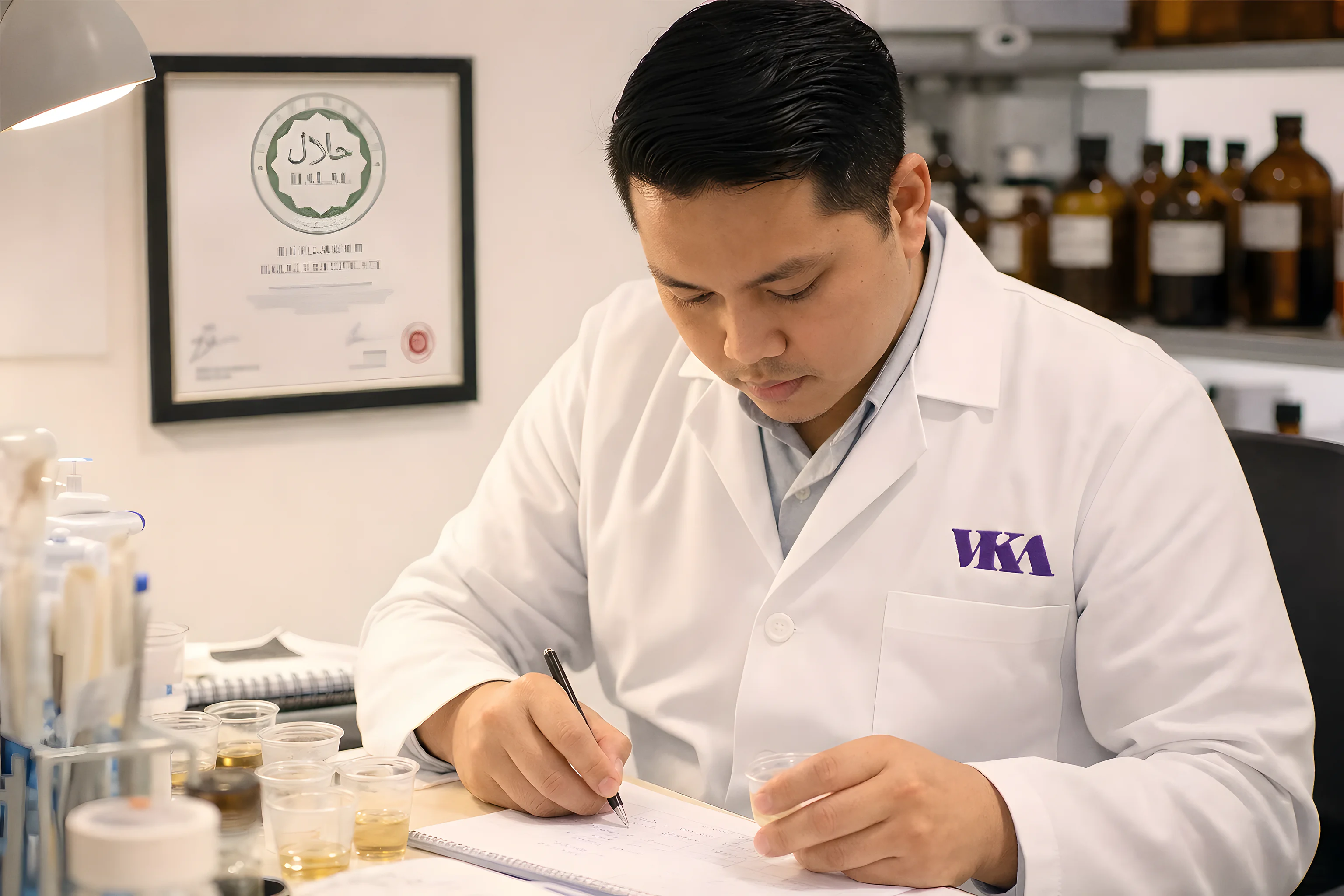
What we can state is what we hold. VKA is MUIS halal certified in Singapore, covering our premises and our flavour range, and we also hold BPJPH certification for Indonesia. Our scope documentation goes out with the sample rather than after the order, so the question of acceptance can be put to your certifier while a flavour is still being chosen rather than once it is specified in. If you are buying for the Philippine market, our flavor supplier page for the Philippines sets out how we supply from Singapore, and the clause-by-clause reference to Philippine flavouring regulation covers additives, registration and labelling with the same citation discipline used here. For how the same question is answered under the Singapore, Malaysian and Indonesian schemes, see our guide to halal flavour certification in Singapore and ASEAN, or talk to a flavourist directly.