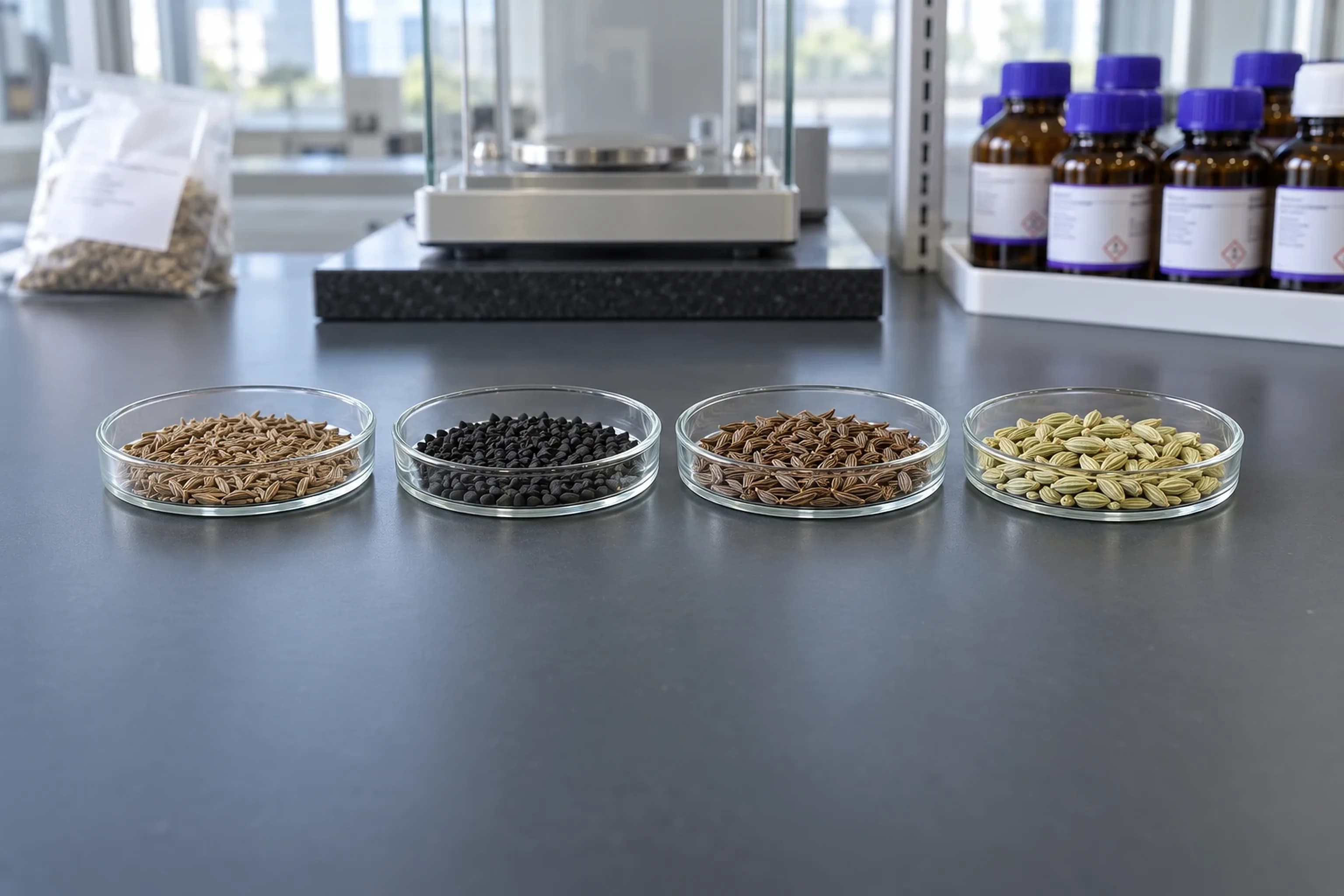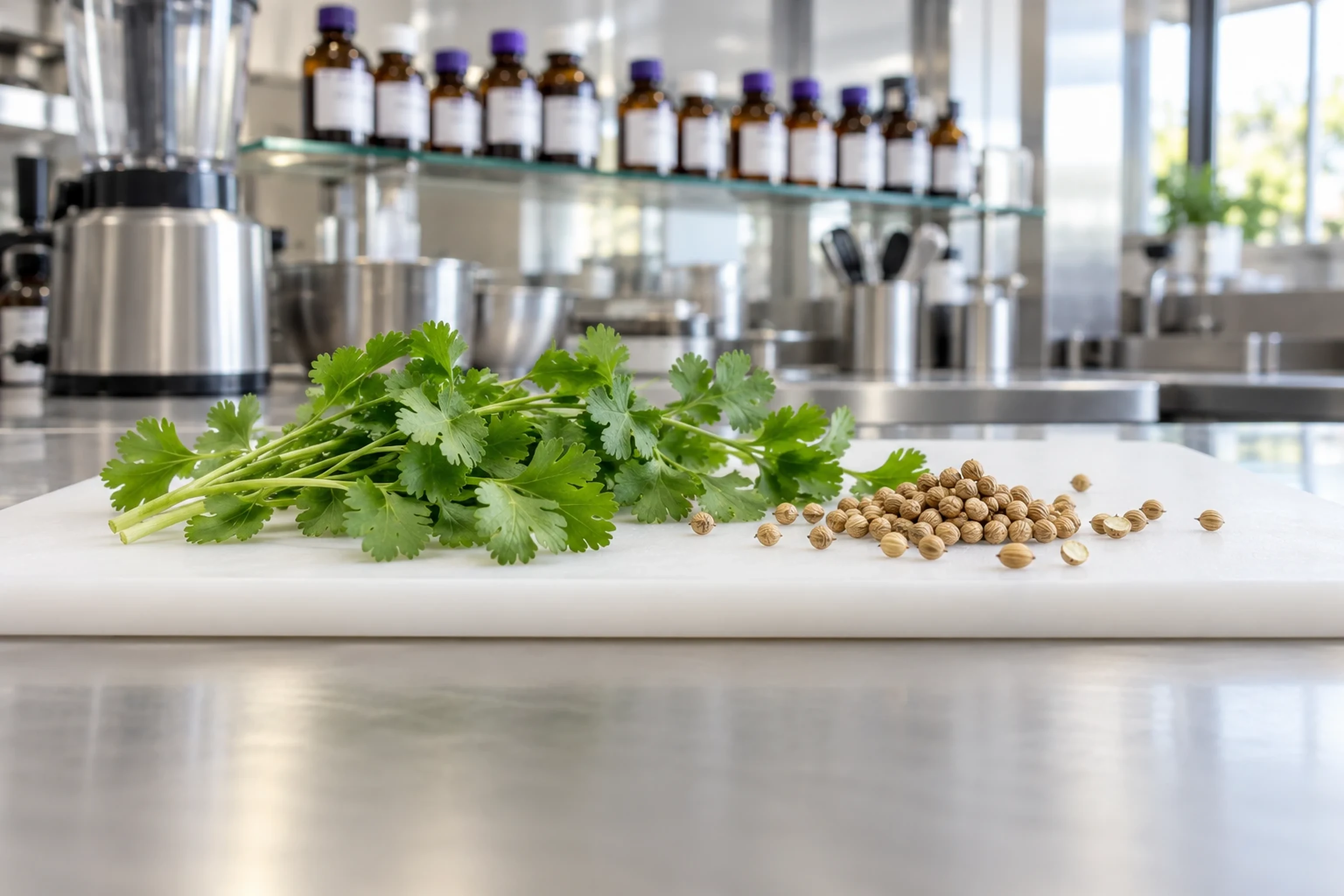
Custom flavour development with a flavour house moves through brief, creation, bench application and sensory evaluation, stability work, then scale-up to production. What happens in between determines whether the project takes weeks or quarters, whether the first production batch tastes like the approved sample, and whether the paperwork clears your regulatory markets. This guide walks through each stage, what it decides, and the questions worth asking a supplier before you commit a launch date to it.
- Brief
- Creation
- Bench application and sensory evaluation
- Stability work
- Scale-up to production
What a Good Flavour Brief Contains
Everything downstream at a flavour house is shaped by the brief. A complete flavour brief contains: the target, either a benchmark product to match or a described profile; the application base the flavour must perform in, such as an RTD tea, a high-protein dairy drink, a baked good or a gummy; the processing the product will go through, such as UHT, retort, baking or freezing, because heat and shear change what survives; the markets the product sells into and the claims it must support; the preferred format, liquid, powder, emulsion or paste; the target dosage and cost-in-use; and the launch timeline. Claims need particular care because 'natural' is a jurisdictional definition, not a general one. A flavour that qualifies as natural under EU Regulation 1334/2008 may be labelled differently under US 21 CFR 101.22, and Southeast Asian markets apply their own adoptions of Codex definitions. A brief that names every target market up front avoids reformulation later. The same applies to halal, kosher, vegan and allergen constraints: they restrict the flavourist's palette and carrier choices, so they belong in the brief, not in round three of revisions.
The Flavourist's First Pass
With the brief fixed, a flavourist builds the first candidates. The working palette spans natural extracts, essential oils and distillates, nature-identical molecules, and artificial molecules where the brief allows them. Like perfumery, a flavour has structure: volatile top notes that register first, mid notes that carry the recognisable character, and base notes that give length and body. The carrier is chosen at this stage too, typically propylene glycol, glycerin, triacetin, vegetable oil or water, with ethanol only where claims and certification targets permit it. Carrier choice is not a detail: it constrains halal certification, labelling and solubility in the final application, which is why experienced flavourists fix it early. First candidates are compounded at gram scale on the bench, evaluated on smelling strips and in simple water or sugar solutions, and narrowed before anything goes near your base.
Bench Application and Sensory Evaluation
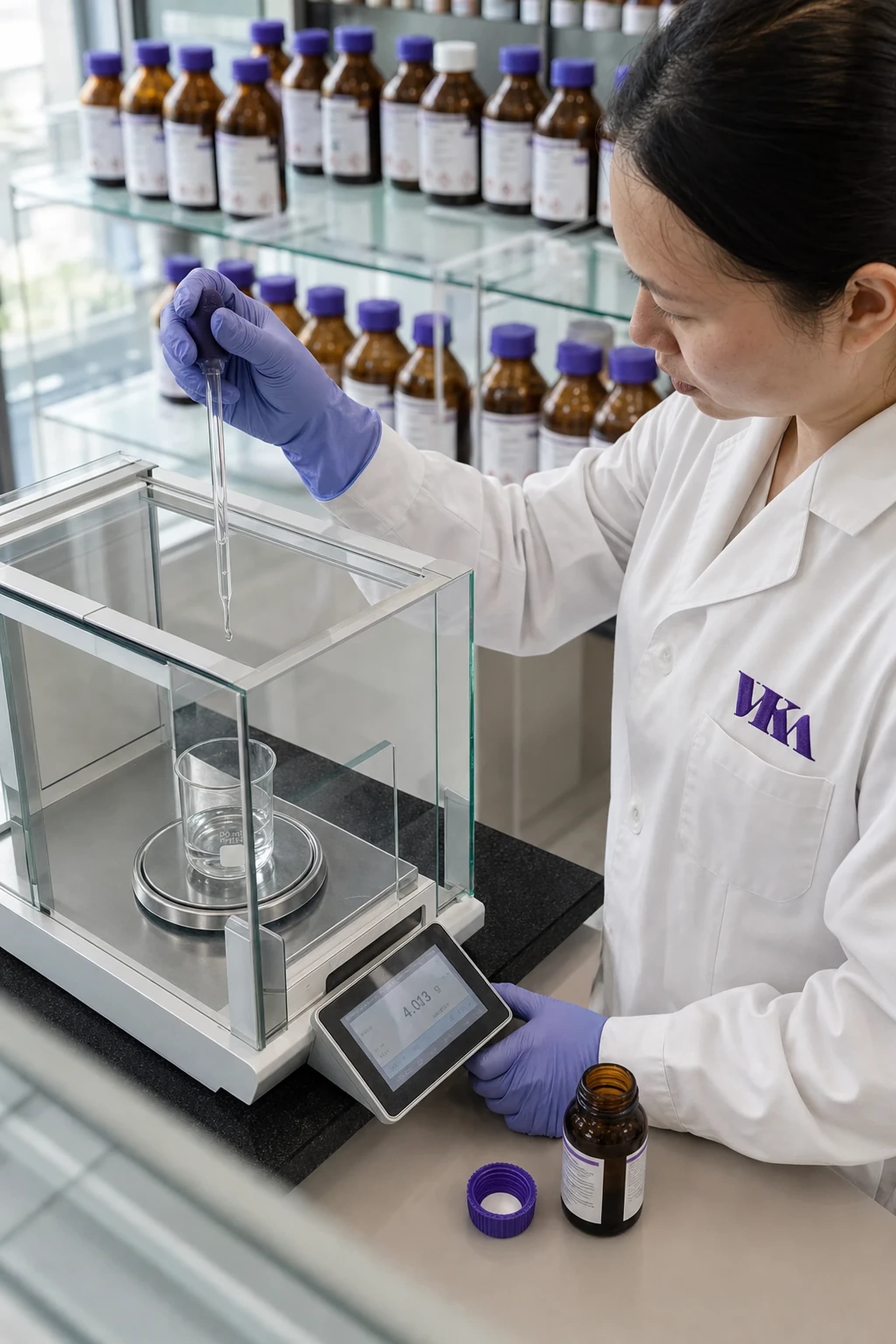
A flavour on a smelling strip tells you almost nothing about a flavour in a finished product. Fat content, protein, pH, the sweetener system and serving temperature all change how a flavour is perceived: proteins bind aroma compounds, fat slows release, acidity sharpens some notes and flattens others. At VKA, our application lab works alongside our flavourists. The candidate flavours are dosed into the actual application base, ideally made to your own formulation, and evaluated by a trained sensory panel against the brief or benchmark. Notes go back to the flavourist, the formula is revised, and the loop repeats. Several rounds are normal for a from-scratch profile; a close benchmark match can take more. This iteration loop, not manufacturing, is usually the largest block of calendar time in a project, which is why a precise brief and fast, specific feedback from your side shorten projects more than anything a supplier does internally.
Stability, Shelf Life and Process Survival
In parallel with profile work, the flavour has to survive the product's life. Heat processes such as UHT, retort and baking drive off volatile top notes and can create cooked off-notes; acidic beverages degrade citrus aldehydes such as citral into compounds that taste stale; light and oxygen oxidise; some proteins bind vanillin strongly enough to mute it. The flavourist compensates by reformulating for the process, overdosing components that will be lost, or protecting the flavour physically. Encapsulation is the main physical route: spray-drying locks flavour into a carrier matrix for powder applications, and the same logic drives technologies such as EssenceLock encapsulation and FreshSeal vacuum-sealed powders. Accelerated shelf-life testing, holding samples at elevated temperature to approximate months of ambient storage, validates the result before launch rather than after.
Precision Fermentation and the 2026 SFA Guidance
One regulatory detail belongs in the stability and documentation conversation for Singapore work. SFA revised its Guidance Information on Requirements for Food Additives on 19 January 2026, and the revision note records that it was “Updated to reflect new technological function included in the Food Regulations, to include general information related to the assessment of new food additive and new additive derived from precision fermentation, and to include FAQs”. If a brief reaches for a fermentation-derived ingredient, that is the route the assessment now follows. The guidance says of itself that it is not legally binding and has to be read with the Food Regulations, so it tells you how SFA will look at a substance rather than granting a permission.
From Pilot to Production
Approval of a bench sample is not the end of development. The formula then scales through a pilot batch that verifies the bench result survives real mixing shear, temperature profiles and order of addition. Production batches are released against a specification: typically a gas chromatography fingerprint checked against the approved reference standard plus an organoleptic check by a trained assessor, so that batch fifty tastes like batch one. Alongside the product itself comes the documentation pack you need for your own compliance: the specification sheet, certificate of analysis per batch, safety data sheet, halal certificate with its scope, and allergen, GMO and nutritional statements. VKA provides this documentation as standard, and every batch is traceable by lot through the supply chain.
What Determines MOQs and Lead Times
Your first two questions are usually these: what is the minimum order quantity, and how long will it take. Both have structural answers. Format drives minimums: liquid flavours compound efficiently at small batch sizes, while spray-dried powders require a drying run, so their minimums are inherently higher, with emulsions in between. Rare natural materials add sourcing lead time that no amount of scheduling removes. Certification paperwork adds calendar time independent of manufacturing, for example halal endorsement of a newly created product. And as noted above, iteration rounds dominate the schedule more than production does. Rather than comparing suppliers on a single quoted MOQ, ask four things: turnaround for a first sample, turnaround for a revision, pilot versus production minimums, and whether specification and certification documentation comes standard with samples. The answers reveal how a supplier actually runs development.
How VKA Runs Development
VKA runs this workflow end to end in Singapore: flavourists, the application lab and the sensory panel work at Ubi, while manufacturing is at Senoko. The Singapore manufacturing site holds FSSC 22000 certification. VKA is MUIS and BPJPH halal-certified, so the documentation pack is standard rather than a special request. Our four stages, brief, creation, refinement and production, are exactly the loop described in this guide. Browse our Capabilities page for how the lab is set up, or talk to a flavourist directly about a brief you are preparing.
Sources
- EU Regulation 1334/2008 on flavourings (natural flavouring definitions)
- US FDA 21 CFR 101.22 - flavour labelling definitions
- IOFI - International Organization of the Flavor Industry
- Singapore Food Agency, Guidance Information on Requirements for Food Additives, revision history entry of 19 January 2026