
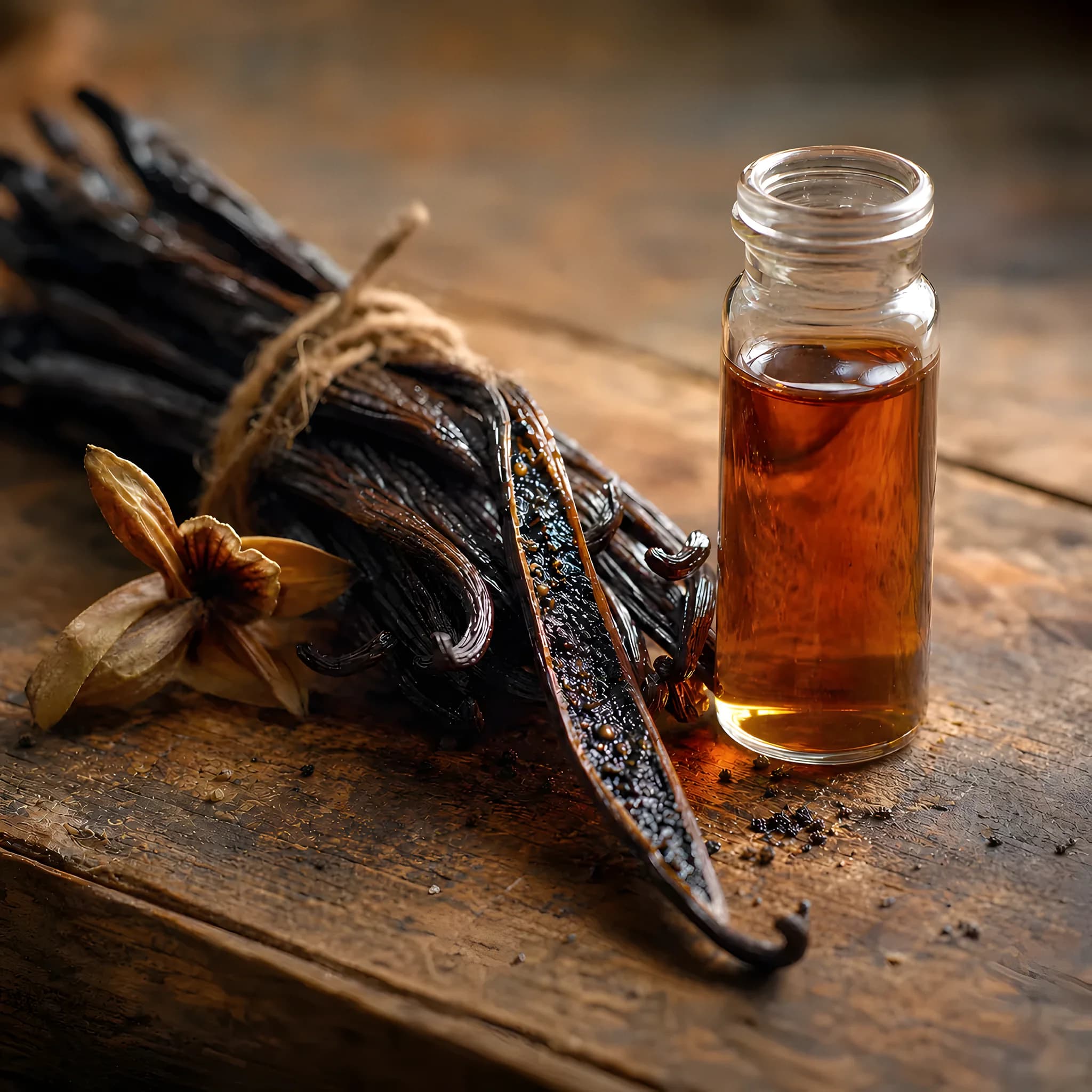
Perisa, perasa, essence, and pewarna are four of the most commonly confused terms when discussing food additives in Indonesia. Some refer to the same thing with a different spelling, while others are entirely different categories with different functions. This guide maps the differences clearly, with references to BPOM regulations, so you do not pick the wrong ingredient or mislabel a product.
The Differences at a Glance
A quick map of the four terms before the detailed explanation:
| Term | Main function | BPOM category | Examples |
|---|---|---|---|
| Perisa | Adds taste and aroma | Flavouring additive (BPOM Reg. 13/2020) | Vanilla, durian, chicken flavour |
| Perasa | Same as perisa | Common term, not the standard term | Everyday spelling of perisa |
| Essence (esens) | Adds aroma, liquid form | A liquid form of perisa | Pandan, vanilla, banana essence |
| Pewarna | Adds or improves colour | Colour additive (BPOM Reg. 11/2019) | Curcumin, carmine, tartrazine |
Perisa, the Official Term for Flavouring
Under BPOM Regulation No. 13 of 2020 on Food Flavouring Additives, perisa (flavouring) is a food additive in the form of a concentrated preparation, with or without a flavouring adjunct, used to impart flavour, except salty, sweet, and sour tastes. The regulation divides flavourings into three categories: natural (perisa alami), nature-identical (perisa identik alami), and artificial (perisa artifisial). Perisa is the standard term BPOM uses in regulation and on labels.
For a full explanation of the three categories, how flavourings are made, and their applications in F&B, see the guide to food flavouring.
Perasa or Perisa, Which Is Correct?
Perasa and perisa refer to the same thing, and the only difference is spelling. Perisa is the standard term used in BPOM regulations and the official Indonesian dictionary, while perasa is the everyday spelling widely used by consumers and on marketplaces. On official documents, packaging, and supplier communication, use perisa. For purchasing and supplier evaluation, see the guide to buying food flavouring.
Essence or Esens, Flavouring in Liquid Form
Essence, or esens, is a common kitchen and baking term for a thin, liquid flavouring that mainly adds aroma. In regulatory terms, essence is still classified as perisa, not a separate category. What sets it apart from flavour pastes or concentrates is only its physical form and concentration: essence is thinner and used in small doses, while flavour pastes are thicker because they are made from extracts that carry more of the food's character, not aroma alone.
Pewarna, an Entirely Different Category
Unlike the first three terms, pewarna is not a flavouring. Pewarna (colour) is a separate class of food additive whose function is to give or improve colour, not taste or aroma. Food colours are regulated under BPOM Regulation No. 11 of 2019 on Food Additives, which sets out the permitted colours and their maximum use limits. Colours are divided into natural ones, such as curcumin from turmeric and carmine from the cochineal insect, and synthetic ones, such as tartrazine and sunset yellow. Because their function and regulation differ, flavouring and colour cannot substitute for each other and must be listed separately on the label.
The Correct Terms for Labels and Documents
On the ingredient list, what is printed is not the name of a regulatory category but the name of the flavouring label group, either "perisa alami" or "perisa sintetik" (PerBPOM 31/2018 Pasal 19 ayat (3) huruf d). The three regulatory categories in PerBPOM 13/2020 Pasal 4 describe how BPOM classifies a flavouring, by source and manufacturing process; a nature-identical flavouring and an artificial flavouring both fall under the "perisa sintetik" label group, under Pasal 14 ayat (3a) as amended by PerBPOM 11/2021. For the colour component, use the appropriate colour name. Avoid mixing in terms like perasa or essence on official labels, since neither is a standard regulatory term.
For halal status, mandatory halal certification applies to finished food products circulating in Indonesia under Law No. 33 of 2014. The deadline was 17 October 2024 for medium and large businesses, while for micro and small businesses the transition period was extended to 17 October 2026 through Government Regulation No. 42 of 2024 Pasal 160 ayat (2). BPJPH's own wording is that this is "Wajib Halal yang akan berlaku pada 18 Oktober 2026", mandatory halal coming into force on 18 October 2026, the day after that transition period ends. As a manufacturer, you need the halal status of every ingredient, including flavourings and colours, to be traceable and documented to support your finished product's halal certificate. For natural claims and labelling, see the guide to natural flavouring.
When to Contact VKA
VKA has developed food flavours in Southeast Asia since 1971, with an FSSC 22000-certified manufacturing site in Singapore. VKA is MUIS and BPJPH halal-certified. More than 5,000 flavour profiles have been developed for F&B manufacturers across ASEAN, including signature Asian profiles such as pandan, durian, coconut, gula melaka, and rendang. Official distribution in Indonesia is through PT Aroma Indonesia Internasional. Learn about VKA's formulation capabilities, or explore the full flavour industry guides.
References
- BPOM Regulation No. 13 of 2020 on Food Flavouring Additives
- BPOM Regulation No. 11 of 2019 on Food Additives
- Codex Alimentarius CAC/GL 66-2008, Guidelines for the Use of Flavourings
- Law No. 33 of 2014 and Government Regulation No. 42 of 2024 on Halal Product Assurance